
The Real Problem Isn’t Data - It’s Attention
Your AE (Account Executive) finishes a strong discovery call. It’s logged in Salesforce. Notes are clear. Next steps defined. Follow up is scheduled.
Then a bigger deal catches fire. A customer escalates. Leadership asks for something urgent. The follow up slips and keeps slipping.
Two weeks later, the prospect signs with a competitor who simply showed up more consistently.
The data was present all along, but the opportunity still slipped away.
This is not a rare edge case. It is the default state of modern sales. When an AE is juggling multiple accounts and opportunities at the same time, things do not occasionally get missed they get missed consistently. The real question is how much revenue is being left on the table due to attention gaps.
Why CRM Logging Doesn’t Solve the Problem
Let’s be clear: logging activities in your CRM is necessary. It creates a record. It enables reporting. It satisfies compliance requirements.
But logging is not the same as managing.
Think of it this way: A security camera records everything that happens in a building. But a security camera doesn’t stop a break-in. For that, you need someone actively watching and responding.
Your CRM is the security camera. It captures what happened. But here’s what it doesn’t do:
- It doesn’t remind your AE that a high-value prospect hasn’t been touched in 12 days
- It doesn’t alert anyone when a champion goes silent after three engaged weeks
- It doesn’t prioritize which of the 47 pending follow-ups actually matters most today
- It doesn’t notice that a deal marked “on track” has early signs of stalling
The data exists across call logs, emails, meeting notes, and activity records. But making sense of it continuously, in real time, across every rep and every deal requires a level of sustained attention that is difficult to maintain manually.
The Juggling Problem: Context Gets Lost at Scale
Sales execution rarely fails because of one big mistake. It fails because of dozens of small attention gaps that compound across a large pipeline.
An average AE may be handling 30–80 active opportunities at different stages , each with different stakeholders, objections, timelines, and internal dependencies. Every deal carries its own context, signals, and next actions.
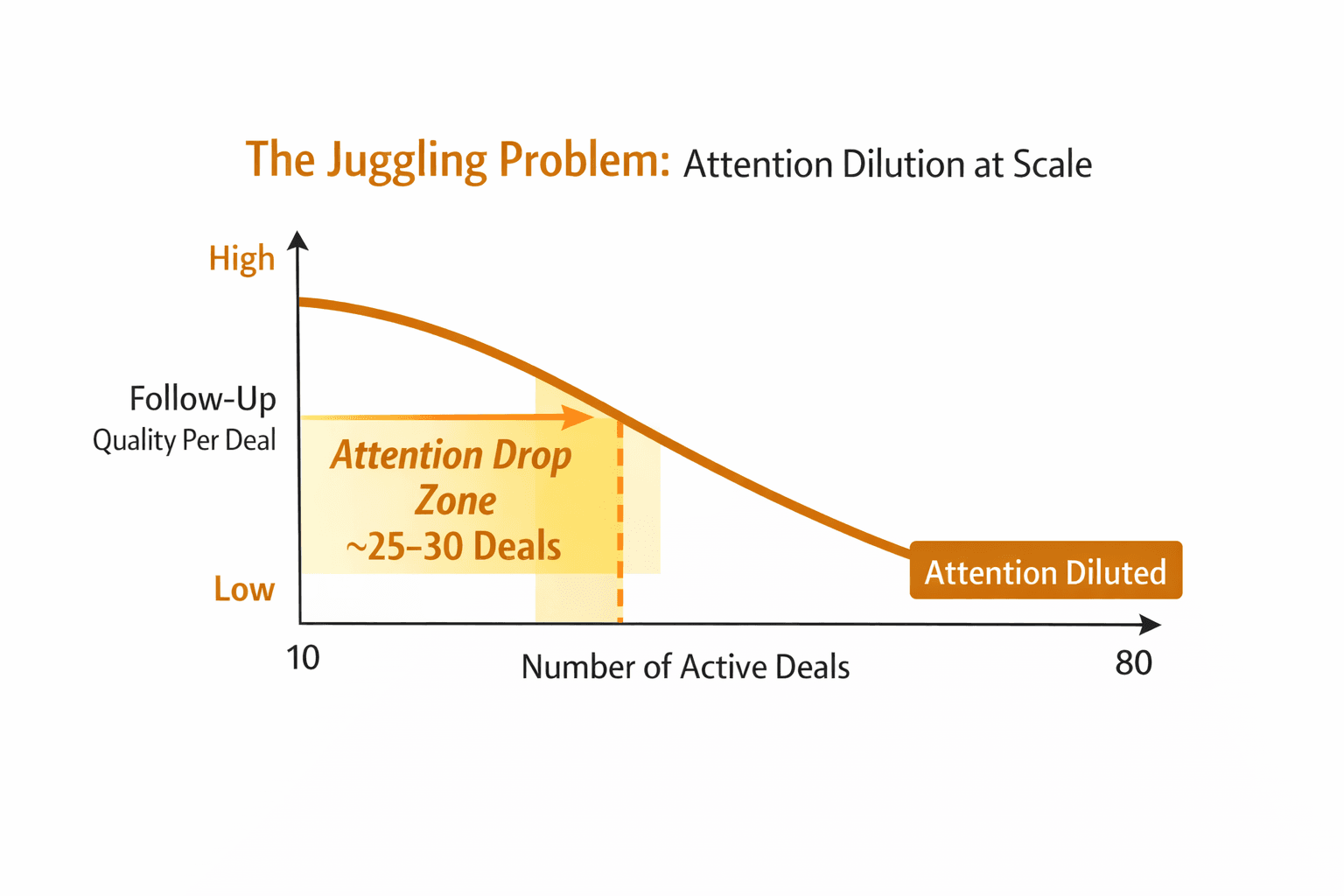
At that scale, prioritization becomes the real bottleneck.
When attention is spread across too many parallel deals:
- High-value opportunities don’t always get timely follow-ups
- Buying signals are noticed late or not at all
- Deal risk indicators surface only during late pipeline reviews
- Effort gets distributed evenly instead of strategically
The result rarely appears as a single visible failure. It shows up as slower cycles, lower conversion rates, and unpredictable forecasts.
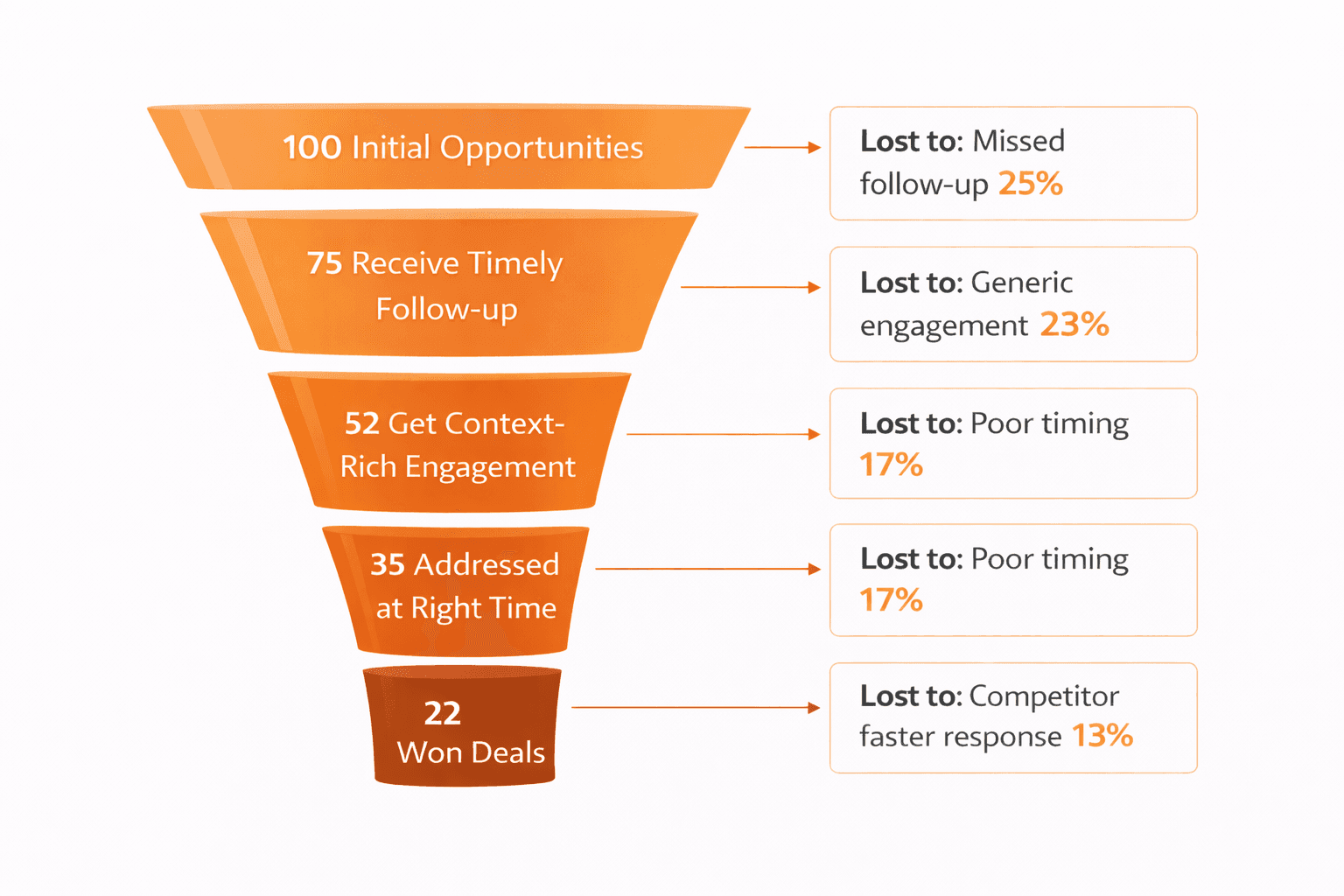
Pipeline leakage is rarely caused by missing data , it’s caused by diluted attention across too many moving parts. The constraint isn’t activity. It’s focus at scale.
What Is AE Capacity, Really?
AE capacity is often measured in headcount, quota, or number of accounts handled. But the more practical definition is simpler: how many deals a rep can actively and effectively advance at the same time.
Two reps can manage the same pipeline size and work the same hours , yet produce very different results. The difference comes from where their attention goes and when they act.
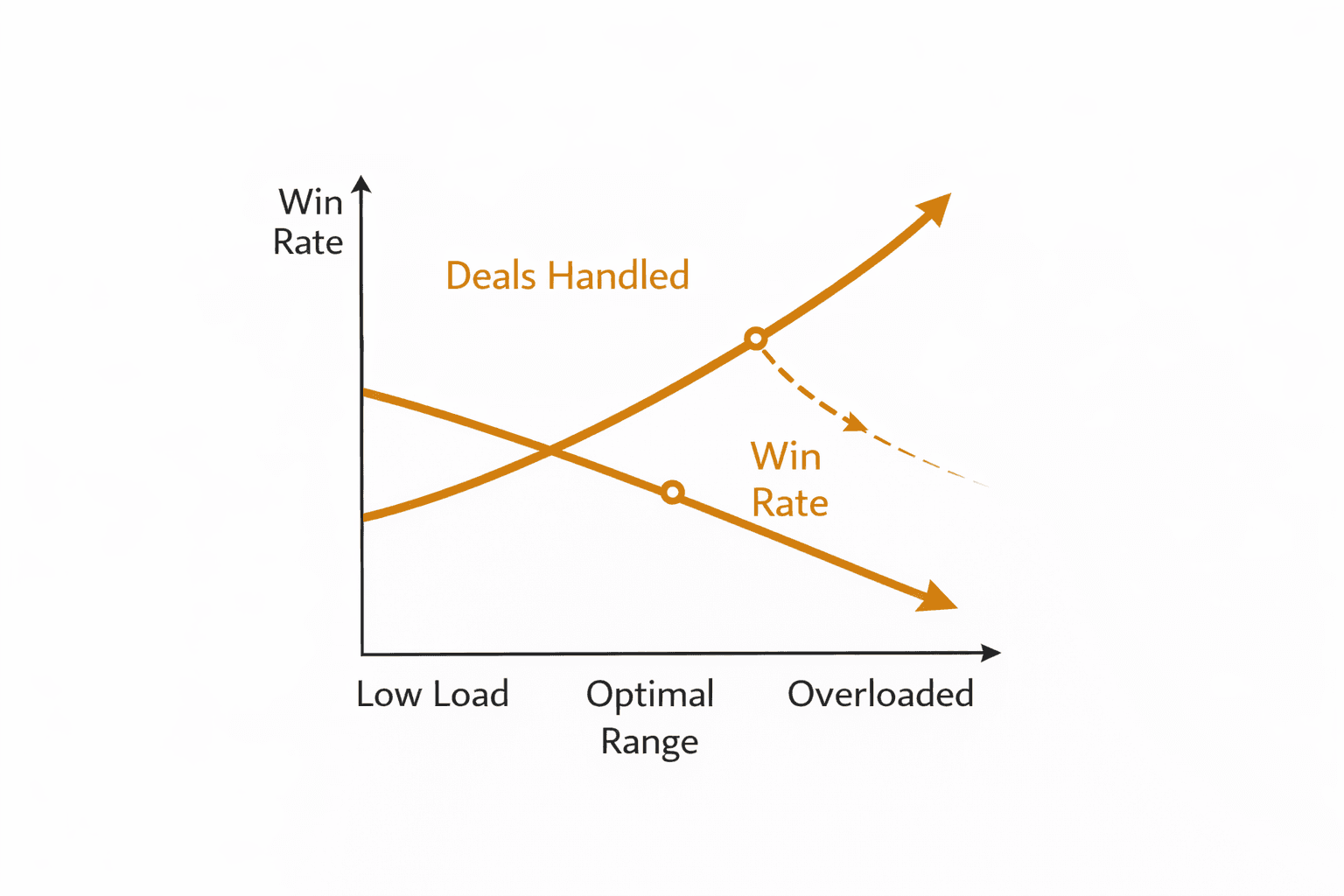
Capacity depends on:
- Focus on the right opportunities - directing effort toward deals with real momentum instead of spreading time evenly across all accounts
- Timing of engagement - acting when buyer signals are strongest, not just when reminders are due
- Access to deal context - having the right history and next steps readily available to avoid restart friction
In other words, capacity isn’t just workload it’s attention applied to the right deals at the right moment.
The Only Real Solution: Deliberate Prioritization
Many RevOps and sales leaders hit a practical limit here. They add process, training, and more CRM fields yet consistent deal-level prioritization remains difficult.
At scale, someone has to continuously monitor deals, reprioritize attention, and surface the right next actions at the right time.
Traditionally, that responsibility is distributed across:
- Sales managers — balancing coaching, forecasting, and team oversight
- RevOps teams — focused more on systems and reporting than live deal tracking
- Reps themselves — already managing heavy opportunity loads
Some teams add coordinators or analysts to track follow-ups manually. It helps but only up to a point. Close monitoring works for a limited number of deals; beyond that, prioritization naturally weakens.
Improving AE capacity ultimately requires a scalable prioritization layer not just more process.
Enter AI Agents: The 24/7 Prioritization Layer
AI agents provide the missing layer between recorded data and daily action a continuous prioritization system that monitors every deal and surfaces what matters next. Not another dashboard, but an always-on intelligence layer inside the workflow.
In practice, this shows up in three core capabilities.
Continuous Priority Re-Ranking
Each day, reps see the most important actions ranked by real deal signals not just CRM due dates. Priorities adjust dynamically based on:
- Deal value and probability
- Changes in buyer engagement
- Recency and quality of interactions
- Stage-appropriate timing
High-value deals with renewed activity automatically rise in priority, so attention follows momentum.
Automatic Context Assembly
When a rep opens a deal, the relevant context is already organized no manual digging across notes and activity history. The agent pulls together:
- Latest conversation summaries
- Open objections and risks
- Key stakeholders and sentiment signals
- Pending commitments and deliverables
This reduces restart time and keeps conversations continuous.
Early Risk & Opportunity Alerts
AI agents detect unusual patterns and surface early signals before they appear in pipeline reviews. For example:
- Engagement drops outside normal patterns
- Deals sit too long in a stage compared to similar wins
- Key stakeholders are looped in but not active
This enables earlier intervention, when recovery is still possible.
What Does This Mean for Your Team?
When continuous prioritization and context support are built into the workflow, AEs recover effective capacity — not to do more admin, but to spend more time moving the right deals forward.
| Without Continuous Prioritization | With AI-Driven Prioritization |
|---|---|
| Start the day sorting inbox and tasks | Start with top actions ranked by deal impact |
| Manually piece together deal history | Key context assembled automatically |
| Spot deal risk during late reviews | Get early risk and momentum alerts |
| Follow up based on calendar dates | Follow up based on buyer signals |
| Same effort spread thin | Same effort focused where it counts |
This is not about replacing reps or judgment. It’s about supporting them with continuous attention at scale, so effort translates more reliably into outcomes.
The Bottom Line
AE capacity is ultimately constrained by how well attention is directed across active deals. Most teams already capture the data , but turning that data into timely action requires continuous prioritization.
AI prioritization layers help close that gap by aligning rep attention with real signals and real deal impact not just task lists and due dates.
What’s Next
If this resonates, start by reviewing how prioritization works across your current pipeline.
- Check a few lost or stalled deals and see when engagement dropped
- Identify which buyer signals best predict momentum or risk
- Ensure those signals are visible and acted on quickly
Most teams may already have the needed data across CRM and communication tools , the opportunity is to turn it into continuous prioritization.
Platforms like Incerto add an AI prioritization layer to your existing stack to support this without changing rep workflow. If you’d like to explore it, we’re happy to share more.