

How underwriting becomes the view your business needs
Are you using underwriting as a revenue lever or just managing it as a process?
Most MGA operators I talk to have the same blind spot. They watch GWP, bind ratios, and submissions. But underwriting gets treated like an operational necessity, not the thing that determines whether the business makes money.
I have sat with some MGA operators to understand this blind spot that comes with not leveraging underwriting well, and how this converts to a bad loss ratio year.
An MGA does not carry risk and does not pay claims. What underwriting helps MGA with is make decisions. Which risks to accept, at what price, under what conditions. Every dollar we earn flows from the quality of those decisions.
Underwriting is not a function inside the business. It is the business.
Underwriting pain points I understand
The problem starts with no real signal. A submission arrives with incomplete data, and the underwriter rates the risk on what is available. That is it. Everything else that actually matters for pricing has to be chased manually.
The loss run was marked to follow. It never followed. We bound the risk anyway. Eighteen months later, the claim told us what the application didn't.
Chasing that missing data takes hours per submission. By the time the underwriter has a complete picture, the agent has already moved to a faster market.
The underwriter finds out the risk was mispriced when the loss ratio starts moving. By then the book has already been built wrong.
Fragmented data slows every decision down, forcing underwriters to stitch together risk pictures manually instead of pricing accurately from the start.
When underwriters don't have complete data at intake, the only lever left is gut feel. And gut feel at scale is just drifting with a delay.
And for MGAs, the downside compounds. You do not carry the risk but you own the decisions that priced it. Every mispriced bind is not just a bad policy. It is a loss ratio point moving against your profit commission, quietly, until it is not quiet anymore.
Revenue lens
When I look at underwriting through a revenue lens, what surprises me is not just how much is being left on the table. It is how quietly it happens.
A $50M GWP book running a 74% loss ratio instead of 60% is not a performance problem. It is a $1.2M revenue problem. Same premium. Same team. Fourteen points of drift in underwriting decisions.
In an industry this mature, this still happens at scale. Not because the data does not exist, but because it does not surface when the decision is being made.
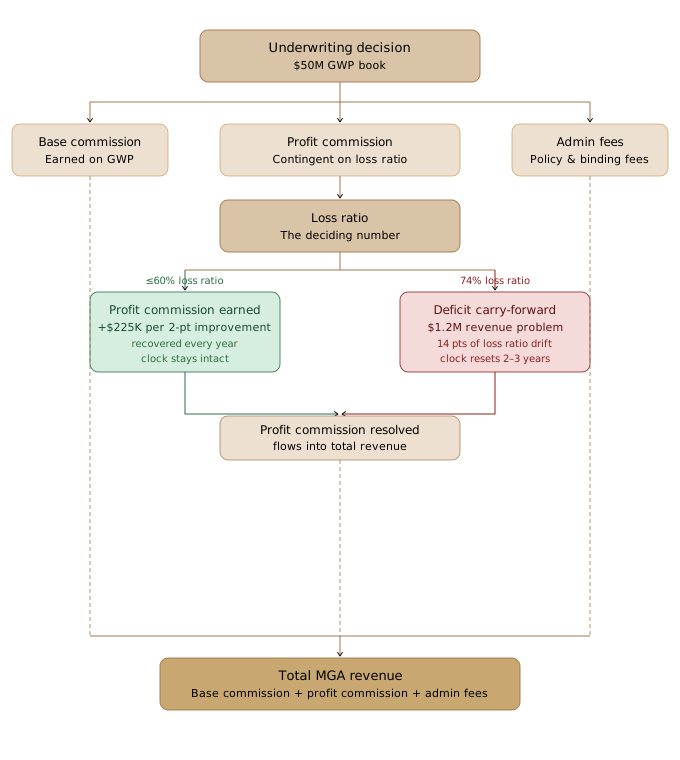
A 2-point loss ratio improvement on a $50M book is $225K in profit commission recovered. Every single year.
And that is before the deficit carry forward kicks in. One bad underwriting year does not just cost you that year. It resets your profit commission clock for the next two to three years, quietly eroding the revenue you thought you had already earned.
The part that is often missed is what the loss ratio is actually made of. It is not one bad year. It is not one bad risk. It is mispriced submissions, guideline drift, and rate erosion accumulating across hundreds of decisions, none of which looked wrong in isolation.
Bad underwriting costs more than revenue
Most MGA operators think about underwriting risk in terms of loss ratios. I did too, until I understood what sits above the loss ratio.
The carrier.
Your binding authority is not a contract. It is a trust position. And it gets repriced every time your underwriting performance gives the carrier a reason to look closer.
A TUI finding does not arrive as a warning. It arrives as a restriction. By then the agents already feel the slowdown, and some of them will not wait for you to fix it.
A restricted authority means risks that used to bind in hours now need carrier referral. Quote turnaround slows. Agents move to faster markets. GWP stalls during remediation. And all of that shows up in next year's numbers before you have had a chance to correct it.
The compounding part is this: carriers allocate their best programs, their best capacity, and their best terms to MGAs with the strongest underwriting track records. Bad decisions do not just shrink your profit commission. They shrink what the carrier is willing to give you next.
You can rebuild a loss ratio. Rebuilding a carrier relationship takes much longer.
Underwriting with Incerto
For me, the problems I described above are not process failures but visibility failures. The data exists. The signals are there. They just do not show up at the moment the decision is being made.
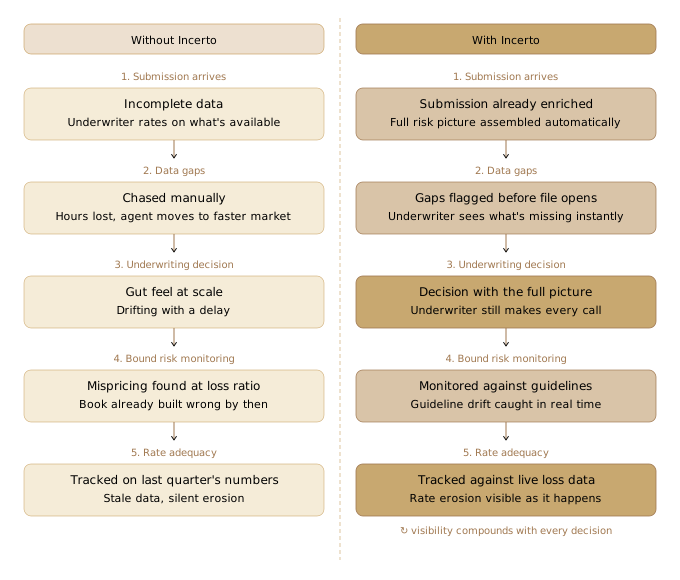
With Incerto, that window closes. Submissions arrive already enriched, data gaps are flagged before the underwriter opens the file, every bound risk is monitored against guidelines in real time, and rate adequacy is tracked against live loss data, not last quarter's numbers.
The underwriter still makes every decision. Incerto makes sure they are making it with the full picture.