
Every organization has a layer of knowledge that nobody writes down.
It's what separates a new hire on their first week from someone who's been there two years. The new hire has access to the same systems, the same data, the same documentation. But they don't know that Sarah in billing always catches the UnitedHealthcare modifier issues before they become denials. They don't know that Aetna tightened medical necessity criteria for knee replacements last quarter. They don't know that the last three appeals on CPT 29881 failed because the op note didn't document a separate incision.
This knowledge doesn't live in any database. It lives in people. It accumulates through trial and error, through hundreds of small iterations, through watching what works and what doesn't. We call it herd knowledge: the institutional intelligence that makes the difference between competent and excellent.
And here's the problem: every AI agent deployed today starts on Day One.
The Day-One Problem
When you onboard a new team member, they go through a ramp-up. They shadow colleagues, make mistakes, learn that certain payers respond to certain arguments. They build mental models of how the organization actually operates, not how the process docs say it should.
AI agents don't do this. They get hand-written context at deployment and operate from that fixed understanding forever. They never discover the unwritten rules. They never build the layered, experience-driven knowledge that turns a competent worker into an indispensable one.
Every agent you deploy today is permanently on Day One. The gap between that and what a tenured employee knows is where most of the value lives.
The Organizational Context Layer
Organizational context is not just data. It's the interconnected web of who actually owns decisions (not what the org chart says), how things actually flow (the real workflows and workarounds), what has been tried (the history of experiments and failures), and what is changing (the early signals experienced people notice and new people miss).
This context sits across structured databases, Slack conversations, informal agreements, and the heads of people who've been there long enough to see patterns. Traditional AI can't touch it because it's built for retrieval, not accumulation.
What if agents didn't reset after every task? What if they accumulated context the way employees do?
This is what we're building at Incerto: a persistent, evolving representation of how an organization actually works, built by long-running agents that observe, execute, learn, and remember.
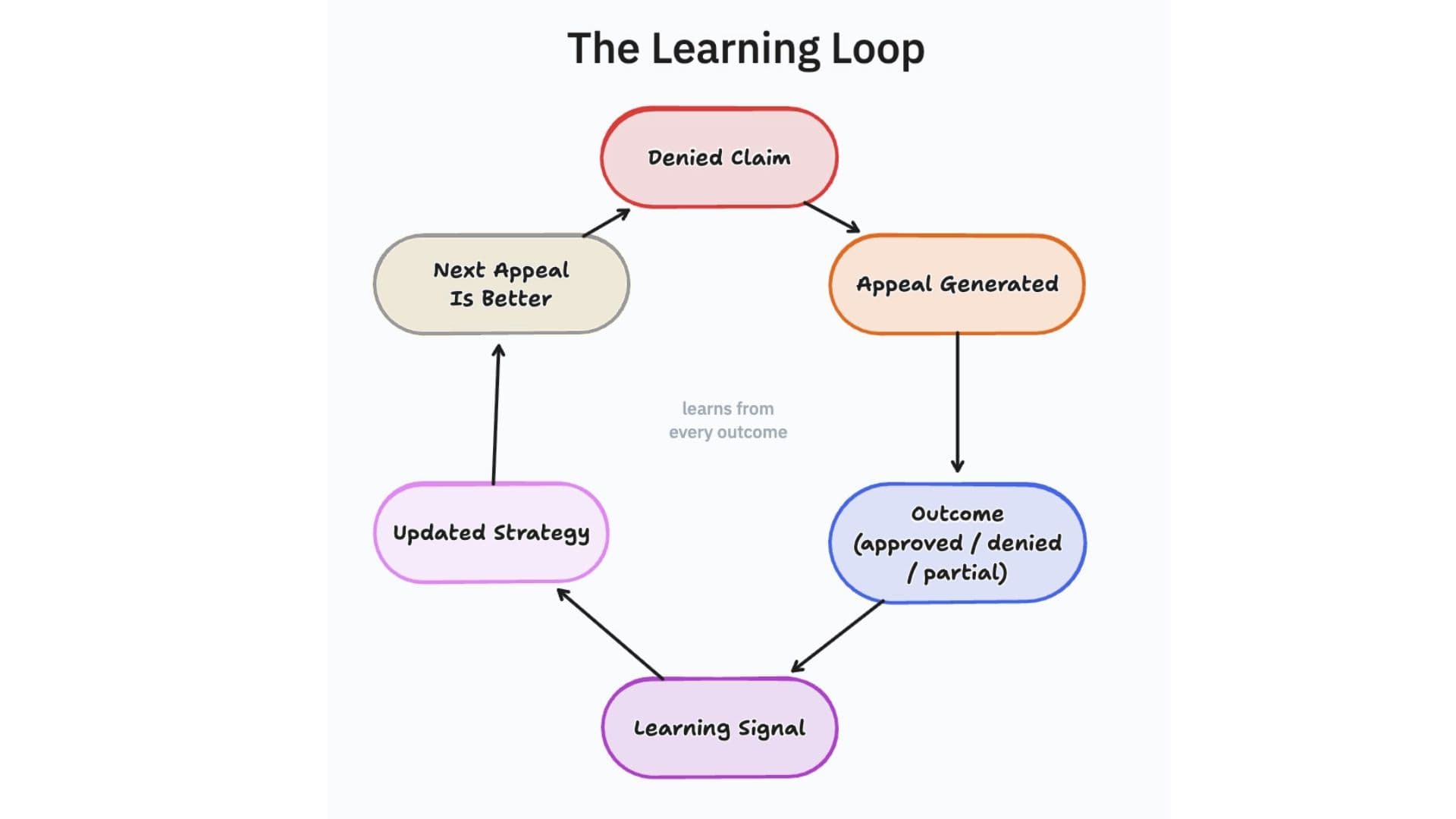
These agents persist across tasks, carrying forward what they learned from every interaction. They build working memory, not static embeddings but a continuously updating model of the organization's patterns. They learn from labeled experience: when an appeal succeeds or fails, they connect the outcome to the strategy that produced it. And they verify continuously, detecting when reality shifts before it becomes a pattern of lost revenue.
Over time, they build something no dashboard and no hand-written prompt can replicate: a living model of how the organization operates and what drives its outcomes.
The Application: Denial Recovery That Gets Smarter
We chose denial recovery for orthopedic and cardiology outpatient centers as the first application. Not because it's the only use case, but because the difference between Day One knowledge and accumulated knowledge is worth hundreds of thousands of dollars here.
An outpatient center has a backlog of denied claims sitting in AR. The billing team sees them but can't get to them because today's cases come first. The denials that need real work — requiring operative notes, payer coverage research, and clinical arguments — keep sliding. The appeal window keeps shrinking. For a mid-sized center, this unworked backlog can represent $500K to$1.5M in recoverable revenue at any given time.
Our system takes these denials, pulls clinical documentation, and builds complete payer-specific appeal packets. But unlike an outsourced appeals service, it learns from every outcome. Over hundreds of appeals, it maps what arguments work with which payers, for which procedures. When a billing person leaves, that knowledge stays. When an RCM vendor declines, the intelligence doesn't walk out the door.
When a payer changes authorization requirements or tightens criteria, the system detects the shift from the first few denials and adjusts before it becomes a revenue problem. A human team might take weeks to notice. The system notices it from the data.
The Network Effect
Everything above describes a single facility. The compounding gets dramatic across multiple facilities.
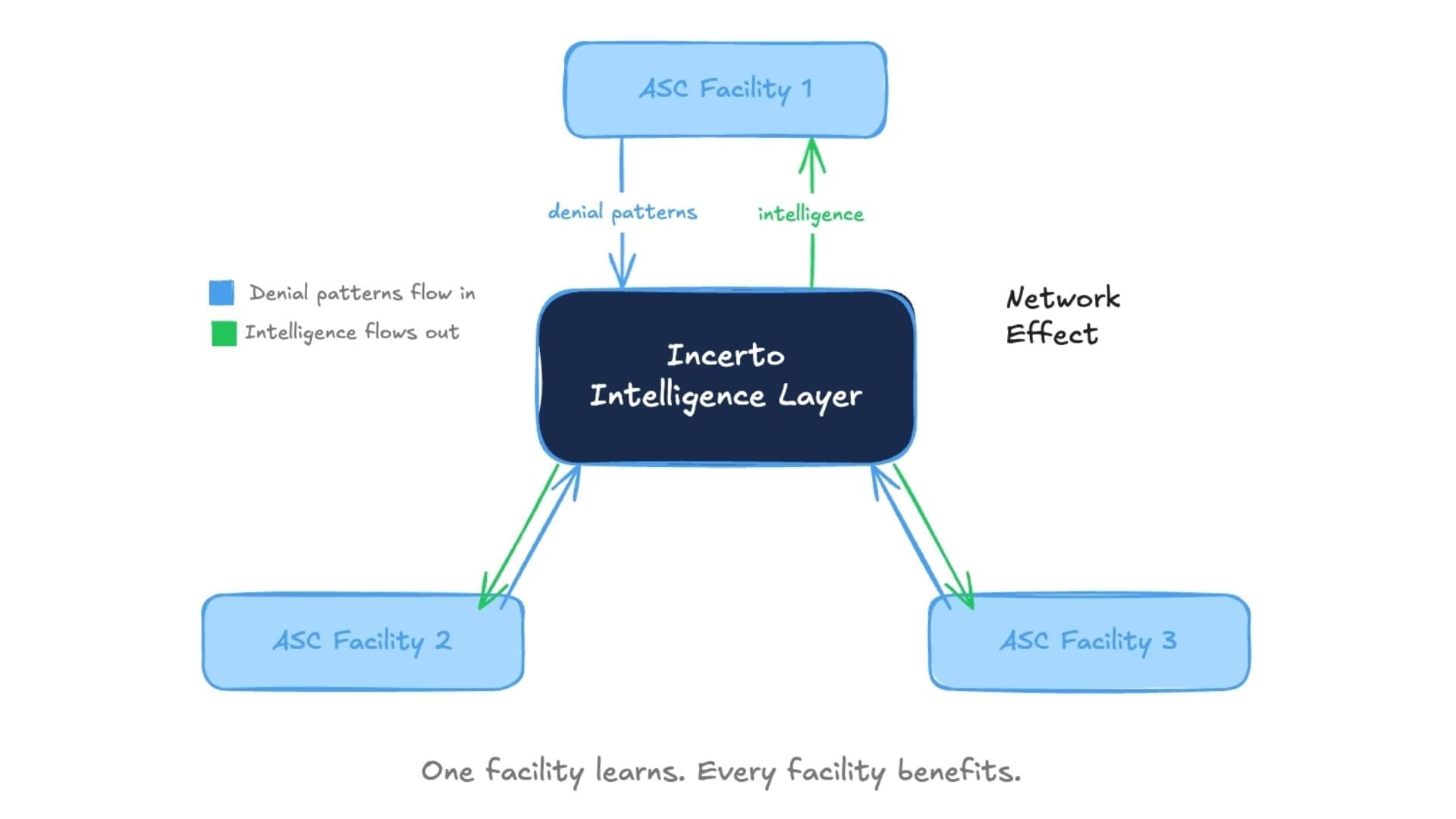
The system learns at one ASC that UnitedHealthcare is rejecting modifier -59 on CPT 29881 unless the op note documents a separate incision. In a traditional setup, every other facility discovers this independently, each one losing revenue on the same denial type.
With the organizational context layer, every other facility benefits immediately. One facility's experience becomes every facility's intelligence — before they ever see the denial.
The more facilities on the network, the faster everyone learns, the fewer denials slip through, the more revenue gets recovered. The first appeal will be good. The hundredth will be categorically better. At portfolio scale, you're not just recovering denied revenue. You're operating on a denial intelligence layer that prevents it from leaking in the first place.
Beyond Denial Recovery
Denial recovery is where we start. But the organizational context layer is general-purpose infrastructure.
Any domain where institutional knowledge compounds — where trial-and-error learning matters, and where the gap between a new hire and a tenured expert is measured in real dollars — that's where this layer changes the game. Underpayment detection, contract compliance, prior authorization optimization, payer behavior prediction.
The answer isn't more data. It's more context, accumulated over time, learned from outcomes, and shared across the organization.
We're building the layer that makes AI agents stop being perpetual new hires and start being employees that never forget, never leave, and get better every single day.