

What an ASC Is and How It Gets Paid
An Ambulatory Surgery Center (ASC) is a licensed, accredited outpatient surgical facility where patients arrive, have a procedure, and go home the same day. Getting paid requires two separate regulatory processes that most new operators treat as sequential when they need to run in parallel.
Accreditation — through AAAHC or The Joint Commission — grants the legal right to operate. It's the milestone every administrator races toward.
Payer enrollment grants the right to bill at in-network rates. It doesn't start automatically when accreditation clears. Each payer requires a separate application, and processing takes 3 to 6 months per payer after submission.
If a facility opens before enrollment completes, every claim submitted to UnitedHealthcare, Aetna, Cigna, or BCBS lands as out-of-network (OON) by default — not due to a coding error or credentialing problem, but simply because the contract doesn't exist yet. OON reimbursement runs 40 to 60 percent below in-network, and that differential compounds across every procedure in the window.
What the Gap Actually Costs
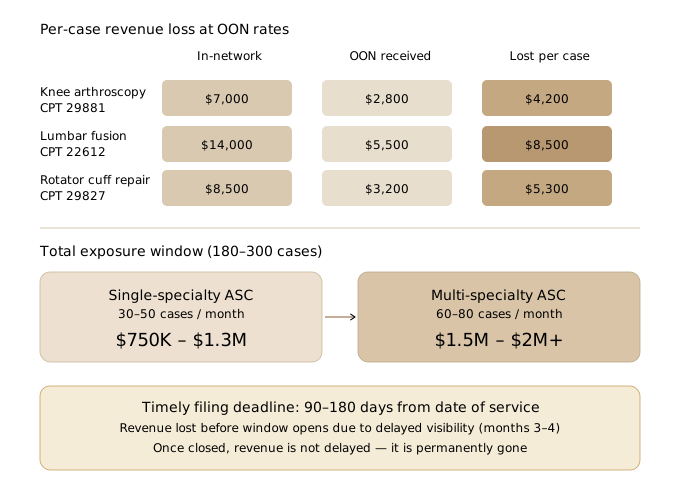
| Procedure | In-Network | OON Rate | Lost Per Case |
|---|---|---|---|
| Knee Arthroscopy (CPT 29881) | $7,000 | $2,800 | $4,200 |
| Lumbar Fusion (CPT 22612) | $14,000 | $5,500 | $8,500 |
| Rotator Cuff Repair (CPT 29827) | $8,500 | $3,200 | $5,300 |
A single-specialty ASC doing 30 to 50 cases per month processes 180 to 300 cases before contracts typically clear. At these deltas, that's a $750K to $1.3M gap. A multi-specialty center doing 60 to 80 cases per month pushes exposure past $1.5 to $2M.
Those figures assume the facility is actively billing OON at all. Most new ASCs have no OON billing infrastructure because they never planned to be in this position — so the actual shortfall is often worse.
A second hard constraint: most commercial payers have timely filing windows of 90 to 180 days from date of service. If those windows close on early cases before anyone has worked them, that revenue isn't delayed — it's gone.
Why New ASCs Don't See It Coming
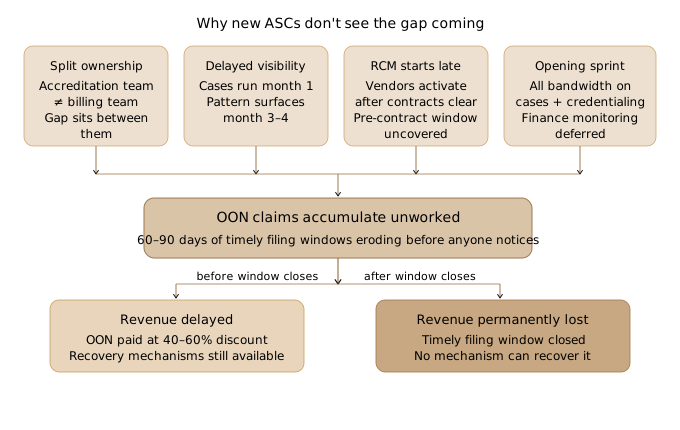
Split ownership. The accreditation team owns compliance. The billing team owns enrollment. Neither is accountable for the gap between them — and that's where the exposure lives.
Delayed visibility. Cases run in month one. The pattern doesn't surface in A/R reports until month three or four, by which point 60 to 90 days of timely filing windows have already elapsed on the earliest cases.
RCM vendors start post-contract. Standard RCM engagements activate after payer enrollment completes. The pre-contract window isn't treated as a revenue risk period.
Opening day urgency. The sprint to run cases and credential surgeons absorbs all available bandwidth. Financial monitoring defers, and the gap accumulates quietly.
The Full Set of Recovery Mechanisms
Most administrators know one or two of these. Facilities that recover the majority of their OON revenue use all of them — in the right sequence, for the right claim types.
Pre-Service Mechanisms
Initiated before the procedure runs
Network Gap Exception
If the payer's network has no qualified in-network provider for the required specialty within reasonable geographic access (typically 50 to 100 miles), the patient or facility can request the claim be processed at in-network rates before the case runs. Payers are obligated by network adequacy standards to grant these when the standard is met. Must be requested and confirmed in writing before the date of service.
Prior Authorization as Rate Leverage
If prior authorization was obtained and the payer's system processed that auth without flagging the facility as OON, the authorization becomes leverage on appeal. The payer approved the service location before the case ran — a record that supports in-network rate treatment, particularly if the patient had no reasonable alternative.
Single Case Agreement (SCA)
An SCA is a one-time, procedure-specific agreement with a payer that sets reimbursement terms for a single encounter in the absence of a network contract. Key requirements:
- Initiate before service is rendered (retroactive SCAs are rarely granted)
- Anchor the rate to a percentage of Medicare or the payer's fee schedule
- Secure written confirmation before billing
- Track each SCA by payer, patient, and CPT
SCAs are non-precedent-setting — the rate on one case does not carry to the next.
NSA Notice and Consent (Balance Billing with Patient Waiver)
For non-emergency, non-ancillary services, the facility can collect the gap between OON rates and billed charges directly from the patient if written informed consent is obtained at least 72 hours before the procedure using CMS standard forms. Cannot be used for ancillary services (anesthesia, pathology, labs, radiology), emergency cases, or situations where no in-network alternative was available.
Claim-Type Specific Mechanisms
Bypasses the OON issue entirely for certain patient populations
Workers' Compensation
Workers' comp operates on a separate billing system governed by each state's fee schedule — commercial network status is irrelevant. Bill the carrier or self-insured employer directly at the applicable state rate. Requires a parallel billing workflow and separate A/R tracking.
Personal Injury Medical Liens (Letters of Protection)
For patients with motor vehicle accident or personal injury cases, the facility can file a medical lien against the patient's legal settlement. A Letter of Protection (LOP) is the agreement executed between the ASC, patient, and attorney. Payment comes from settlement proceeds, often at or near full billed charges.
Medicare and Medicaid Enrollment
Medicare enrollment via CMS Form 855B runs on its own timeline, independent of commercial contracts. Medicare rates are fixed and apply regardless of commercial contract progress. Many new ASCs deprioritize federal enrollment while chasing commercial contracts, leaving federal revenue uncollected during the OON window.
Post-Service Mechanisms
Claim-level work after the case runs
ERISA Direct Appeals
Approximately 60 percent of commercially insured patients are on self-funded employer plans regulated by federal ERISA law, not state insurance law. For these patients, the facility can bypass the insurer and appeal directly to the plan administrator. Many Summary Plan Documents (SPDs) specify OON rates as a percentage of billed charges rather than Medicare — which can be materially more favorable.
Payer Internal Provider Dispute Resolution (PDR)
Every major payer runs its own internal dispute process. UHC, Cigna, Aetna, and BCBS each have PDR mechanisms that are faster than federal IDR and carry no per-claim fees. These should be exhausted before escalating to state or federal processes.
State-Level Surprise Billing Dispute Processes
Texas (TASB), California, New York, and Georgia operate state-level dispute resolution frameworks with different benchmarks and timelines than federal IDR. For fully insured plans, state law applies and state processes may be more favorable.
Federal IDR (Independent Dispute Resolution)
The backstop for unresolved OON payment disputes under the No Surprises Act. After the claim is paid, provider and payer enter a 30-day open negotiation window. If unresolved, either party can initiate IDR within 4 business days of negotiation closing. Each party submits a payment offer; the IDR entity selects one whole, and the losing party pays the admin fee ($350 to $600 per claim). The IDR entity weights the QPA (payer's median in-network rate) as the presumptive benchmark — best used selectively on high-value cases.
Prompt Pay Interest
Most states require payers to adjudicate clean claims within 30 to 45 days. Late payment triggers statutory interest, typically 1 to 1.5 percent per month. For a facility with hundreds of OON claims in slow adjudication, systematically tracking and billing for this adds up — but very few facilities do it consistently.
Retroactive Contract Effective Date
If enrollment was submitted promptly and processing delays were attributable to the payer, some payers will negotiate backdating the contract to the facility's accreditation or CMS certification date. Requires documentation of the original submission date and a direct request to the payer's provider contracting team. Where granted, it eliminates the OON gap retroactively.
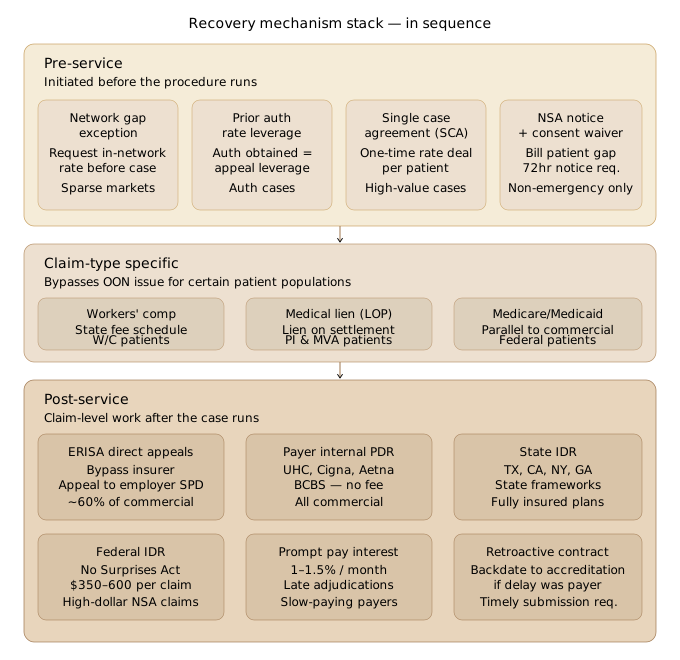
The Recovery Stack in Sequence
| Mechanism | Timing | Best Applied To |
|---|---|---|
| Network gap exception | Pre-service | Specialty-sparse markets |
| Prior auth rate leverage | Pre-service | Cases where auth was obtained |
| Single Case Agreement (SCA) | Pre-service | High-value cases, per-payer |
| NSA notice and consent waiver | Pre-service (72hr) | Non-emergency, non-ancillary only |
| Workers' comp billing | Day one setup | W/C patient population |
| Medical lien (LOP) | Case-by-case | PI and MVA patients |
| Medicare/Medicaid enrollment | Parallel to commercial | Federal program patients |
| ERISA direct appeals | Post-service | ~60% of commercial claims |
| Payer internal PDR | Post-service | All commercial underpayments |
| State IDR | Post-service | Fully insured plans, favorable states |
| Federal IDR | Post-service | High-dollar claims, NSA-covered |
| Prompt pay interest | Post-service | Slow-paying payers |
| Retroactive contract backdating | Post-contract | If submission was timely |
Why Most of This Goes Unused
Each mechanism on this list requires specific infrastructure to execute: the right timing, the right documentation, knowledge of which claims are ERISA-governed vs. fully insured, state-specific prompt pay rules, payer-specific PDR processes, SCA tracking by patient and CPT, and timely filing monitoring across every claim. No single billing team member holds all of this simultaneously.
Standard RCM vendors don't cover most of it either. Their engagements start after payer contracts clear. The pre-contract window — and the specialized post-service recovery work that applies to it — sits outside the scope of most existing billing relationships.
During the opening sprint, nobody is managing any of it. By the time the financial pattern surfaces in A/R reports, filing windows on the earliest cases have already closed.
How Incerto Covers the Full Stack
Each mechanism on this list requires specific infrastructure: the right timing, the right documentation, knowledge of which claims are ERISA-governed vs. fully insured, state-specific prompt pay rules, payer-specific PDR processes, SCA tracking by patient and CPT, and timely filing monitoring across every claim. Standard RCM vendors don't cover most of it — their engagements start after payer contracts clear.
Incerto runs AI agents continuously across the revenue cycle, built around your facility's specific payer mix, case history, and claim patterns. The agents track every OON claim from submission, monitor timely filing windows, identify ERISA-governed claims and route appeals accordingly, flag SCA and gap exception opportunities before cases run, prepare IDR-ready documentation on qualifying underpayments, and detect payer behavior shifts in days rather than weeks.
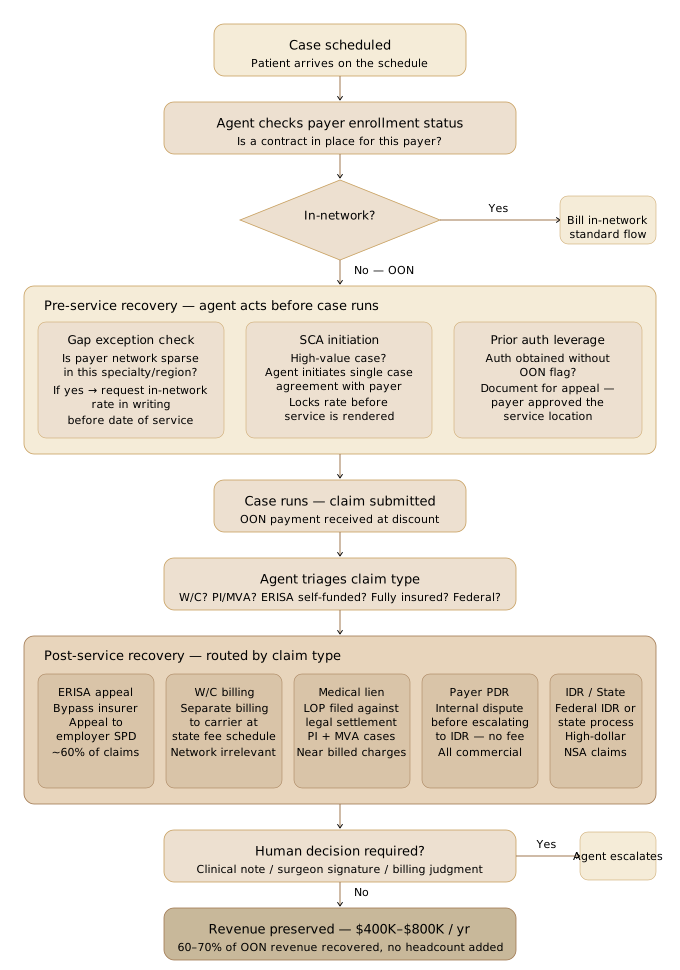
When a human decision is genuinely required — a clinical note, surgeon signature, or billing judgment call — the agents escalate. Everything else runs continuously in the background.
For a new ASC running 800 to 1,000 cases in year one, that means every recovery mechanism applied to every eligible claim, no timely filing windows missed, and 60 to 70 percent of OON revenue that would otherwise go unworked recovered — typically $400K to $800K in first-year revenue without adding headcount.
The OON window is a defined, predictable exposure. The question is whether you have the infrastructure to work all thirteen levers from day one, or whether you find out what it cost you after the filing windows close.