
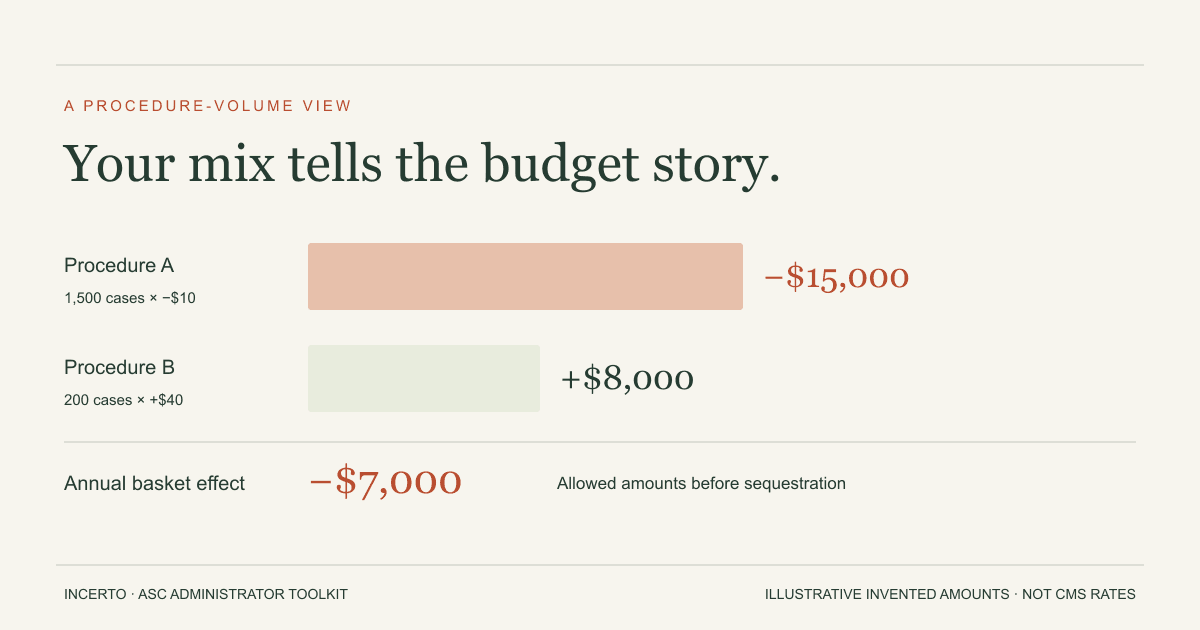
In a simple Incerto arithmetic example, a ten-dollar change multiplied by 1,500 procedures is $15,000; a hundred-dollar change multiplied by 20 procedures is $2,000. That is the reason for this guide's approach to 2027 ASC Medicare budget impact: calculate the change using your own mix and volume.
CMS identifies a 2.3% ASC update factor for centers meeting the relevant quality-reporting requirements. CMS 2027 final-rule fact sheet, “Updates to OPPS and ASC Payment Rates”. Our planning interpretation is to use that as context, then compare individual rates: CMS also uses procedure weights and alternative payment methods, so the update factor alone does not establish a center's revenue change. CMS Medicare Payment Systems guide, “Ambulatory Surgical Center,” “Setting Payment Rates”.
Our suggested question for an ownership meeting is narrower: what happens to the same basket of original-Medicare procedures when we change the rate period? The formulas, comparison tables, and workflow below are Incerto's planning method, not a CMS forecast or required budgeting process.
Build a consistent 2027 ASC Medicare budget comparison
Begin with a small worksheet: procedure label, annual original-Medicare volume, baseline rate, comparison rate, and payment-treatment notes. In the Medicare ASC budget workspace, you enter the rates you have verified from the linked sources. The workspace calculates volume-weighted changes from those inputs; it does not look up rates or confirm that a procedure qualifies for separate payment. Use aggregated counts. Patient names, dates of birth, and account numbers are unnecessary for this planning exercise.
For this toolkit, the baseline is 2026 Q4 and the comparison is the 2027 final rule. This holds a late-2026 rate schedule constant across the baseline basket. It does not reproduce all rates actually paid during 2026. CMS maintains the quarterly ASC payment files if you need a date-specific historical analysis.
Keep the geographic basis consistent as well. CMS applies a wage adjustment to eligible ASC services. CMS Claims Processing Manual, Chapter 14, §40.2. Our comparison method uses national rates in both periods or supported local rates in both periods, so a change in geography is not mixed with a change in the rate schedule.
For each eligible standalone procedure, our illustrative arithmetic is:
Rate effect = annual original-Medicare volume × (comparison rate − baseline rate).
Add the dollar effects across the supported procedure basket. To calculate the basket's percentage change, divide the total dollar effect by the total baseline allowed amount. Averaging the percentage changes of the individual codes can give the wrong answer because the codes carry different volumes and dollars.
A mixed-procedure example using invented inputs
The table below is Incerto's original illustrative arithmetic, using entirely invented inputs. Procedure A and Procedure B are placeholders, not actual codes or published Medicare rates. Assume separately payable standalone procedures, identical volumes in both periods, and the same geographic basis. No CMS rate dataset is the source of these amounts.
| Procedure | Annual original-Medicare volume | Baseline allowed amount | Comparison allowed amount | Annual rate effect |
|---|---|---|---|---|
| Procedure A | 1,500 | $800 | $790 | −$15,000 |
| Procedure B | 200 | $2,000 | $2,040 | +$8,000 |
| Basket total | 1,700 | $1,600,000 annually | $1,593,000 annually | −$7,000 |
From those invented inputs, Procedure A's reduction outweighs Procedure B's increase. The basket falls 0.4375%, or about 0.44%, before sequestration and collection effects. This example defines its inputs as total facility allowed amounts, including the beneficiary portion; Medicare.gov's ASC cost explanation distinguishes beneficiary cost sharing from the total approved amount. The table does not model Medicare checks or cash collections.
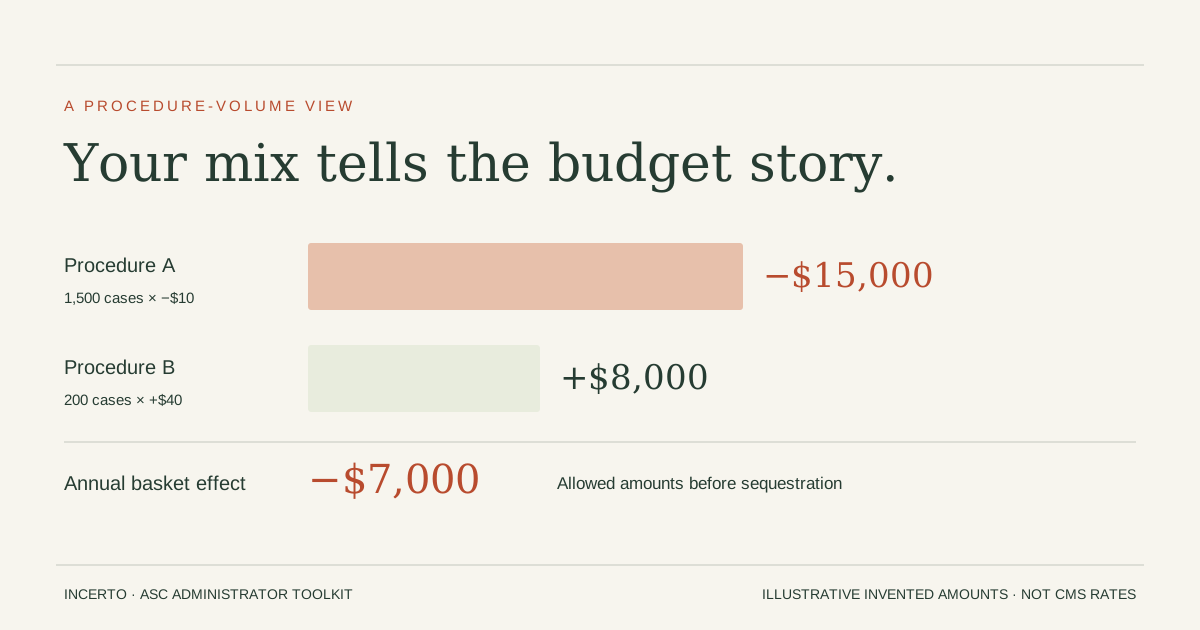
Figure: Incerto's invented inputs and arithmetic from the table above, not published CMS rates. Policy context: CMS's 2027 update-factor explanation; this figure is not a prediction of that update's effect on an ASC.
An unweighted average of the two code-level percentages would suggest an increase. The volume-weighted dollar calculation shows a decrease. This is why the procedure basket should be the center of the discussion.
Separate rate changes from volume and collection assumptions
We recommend a second scenario for next year's expected volumes after the fixed-volume comparison. This Incerto planning table separates the assumptions:
| Question | Hold constant | Change |
|---|---|---|
| What is the fee-schedule effect? | Procedure mix and volume | Rate period |
| What happens if volume changes? | Selected rate schedule | Procedure counts |
| What might we actually collect? | Explicit payment assumptions | Denials, patient collections, timing, and other collection inputs |
In the illustrative example, 100 additional Procedure B cases at the comparison rate add $204,000 to modeled allowed amounts. That is a volume assumption. It does not reverse or erase the original $7,000 rate effect.
Show both figures to owners. Otherwise an optimistic growth assumption can hide a reimbursement reduction, or a pessimistic volume assumption can make a rate change appear worse than it is.
For a margin discussion, we recommend adding a separate cost view with your own staffing, supplies, implant, and room-time assumptions. For related Incerto commentary, see our ASC administrator workflow article; it is not a source for Medicare policy.
Exclude unsupported rows instead of assigning them zero
Our planning recommendation is to state what the total covers and leave an unexplained missing rate unresolved. CMS describes packaged items and separately payable services in Claims Processing Manual, Chapter 14, §§10.2 and 30; these are distinct payment treatments, not interchangeable zero-dollar inputs.
We suggest three review groups, as an Incerto worksheet convention:
- Comparable: supported standalone procedure with usable rates in both periods.
- Needs review: changed code, missing period, unsupported local adjustment, or payment-method exception.
- Outside this model: other payers, physician/anesthesia services, and scenarios requiring claim-level pricing.
Count the unresolved rows and their submitted volumes beside the supported total. If you entered 2,000 cases but only 1,700 were modeled, label the result a subtotal for the 1,700 cases. A mathematically correct subtotal can still mislead when it looks complete.
Multiple-procedure and device adjustments can change claim payment. CMS Claims Processing Manual, Chapter 14, §§40.5, 40.7, and 40.8. Our worksheet does not apply those rules; do not sum every encounter code at its full standalone rate and treat the result as a claim price.
If you have a commercial contract expressed as a percentage of Medicare, our recommendation is to review that agreement separately: which schedule and year does it incorporate, and how does it handle updates and exceptions? This worksheet's original-Medicare scope does not establish a contracted amount for another payer.
Take a decision sheet to the owners
Our suggested decision sheet is a short explanation the group can challenge, not a CMS reporting requirement:
- The exact releases and national or local payment basis.
- The fixed-volume change in facility allowed amounts.
- The procedures contributing the largest dollar increases and decreases.
- The modeled volume, unresolved volume, and excluded scenarios.
- The separate volume and collection assumptions used in the operating budget.
- The person responsible for checking the January addenda.
We recommend keeping claims follow-up separate from the schedule comparison. For related Incerto commentary on a different workflow, read prioritizing receivables by value and deadline.
Build a budget scenario with your verified rates and use the payment breakdown guide when a reviewer asks how allowed amounts differ from Medicare's payment.
Sources and scope
Public payment-policy sources are linked beside the statements they support. ASCA's public payment-resources page, “2027 Final Rule Rate Calculator”, says official first-quarter rates will be published in the January payment addenda around January 1, 2027. Check that release for changes before using final-rule figures for billing. Sources were checked November 15, 2026 and may subsequently change.
All example inputs, formulas, totals, figures, and planning conventions in this article are Incerto's original illustrations, not sourced CMS rates or an official projection. Internal article links are related reading. The worksheet models user-entered rates and volumes for standalone ASC facility procedures; it is not a complete revenue forecast, profitability analysis, or claim repricer.
Educational reference only. Incerto provides this resource as is, without warranties of accuracy, completeness, currency, or fitness for a particular purpose. It is not medical, legal, billing, coding, or financial advice, an official CMS or ASCA publication, or a guarantee of coverage or payment. Examples are invented; worksheet results depend on user-entered inputs that Incerto does not verify. Verify the current CMS release and applicable Medicare Administrative Contractor guidance before billing, patient estimates, or financial decisions. To the extent permitted by law, Incerto disclaims liability for losses arising from use of this resource. Source links do not imply endorsement.