
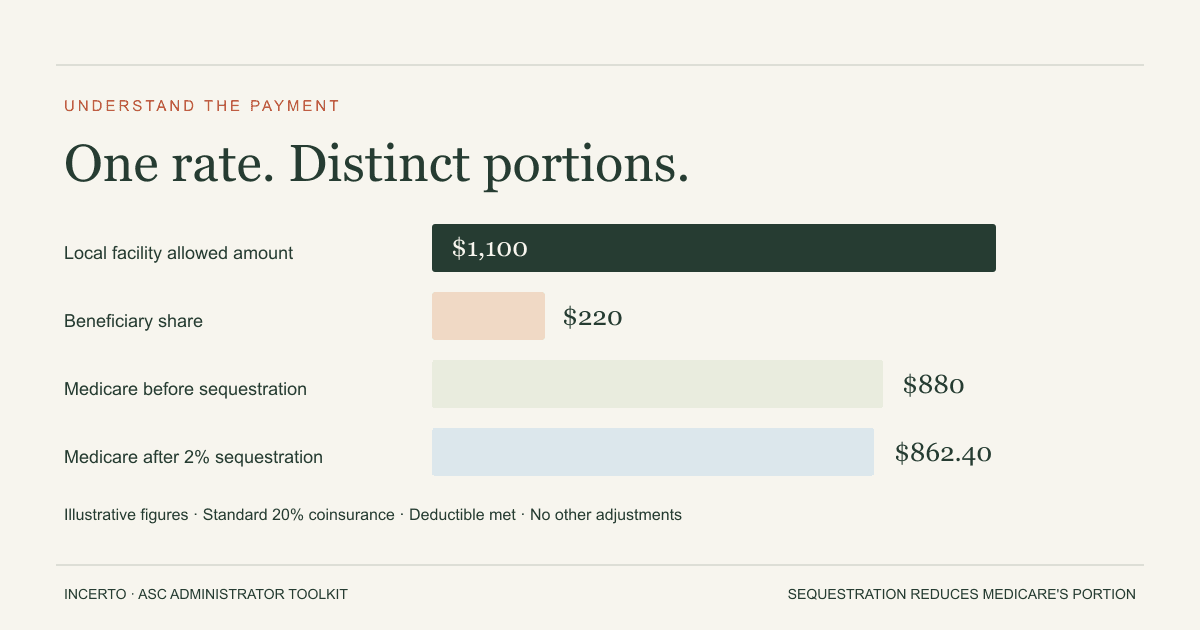
In this guide's invented example, a facility allowed amount is $1,100 and the modeled Medicare portion is $862.40. This is Incerto's arithmetic illustration, not an actual rate, remittance, or finding of underpayment.
The example assumes a 20% beneficiary share after the deductible is met and 2% sequestration on Medicare's portion. The policy sources are Medicare.gov's ASC cost explanation and Noridian's Medicare FFS sequestration guidance. Understanding how Medicare ASC payments work means keeping those portions separate and checking which rules apply to the actual service.
This guide walks through that example, then identifies where a simple rate calculation needs more information. The worked dollar amounts, sample wage-index value, decision table, and graphics are Incerto's original illustrations; workflow suggestions are our recommendations. They are not code-specific rates, patient estimates, or CMS instructions.
Start with the ASC facility payment
The ASC facility payment and a physician's professional payment are separate components. CMS Claims Processing Manual, Chapter 14, §§10 and 10.4. We recommend labeling them separately rather than using a surgeon's fee-schedule amount as the center's facility reimbursement.
When someone asks “what will Medicare pay?”, we suggest this Incerto decision table, not an official CMS checklist:
| They are trying to decide… | The relevant starting point |
|---|---|
| What is the published facility rate? | The ASC payment file for the applicable period |
| How does our location affect it? | The applicable geographic inputs and code-specific method |
| What portion comes from Medicare? | The allowed amount, beneficiary portion, and applicable adjustments |
| What should this patient pay? | A patient-specific benefits and coverage review |
| Why did this claim pay differently? | The actual claim, remittance, coding, and payment rules |
For the source framework behind those distinctions, see CMS's ASC payment overview, CMS's ASC payment-method explanation, and Medicare.gov's ASC costs and coverage guidance. Our rate-source guide is related Incerto reading.
How the national rate becomes a local amount
CMS applies geographic wage adjustment to the 50% labor-related share of eligible ASC services. CMS Claims Processing Manual, Chapter 14, §40.2. For a standard rate subject to that method, Incerto expresses the simplified arithmetic as:
Local facility amount = national facility amount × (0.50 × wage index + 0.50).
For our invented national amount of $1,000 and invented wage-index input of 1.20, half the amount, $500, becomes $600. The other $500 remains unchanged. The illustrative result is $1,100; neither input is a published rate for a code or location.
This is not a universal repricing formula. CMS describes different methods for device-intensive procedures, office-based procedures, and certain ancillary services, along with geographic adjustment protections. CMS Medicare Payment Systems guide, ASC “Setting Payment Rates” and “Alternative Payment Rate Methods”.
CMS publishes wage-index and supplier-specific files with the 2027 ASC final-rule downloads. We recommend checking the applicable method and period, verifying supplier-specific treatment where relevant, and preserving unrounded working calculations until the final display.
Split the beneficiary portion before sequestration
For the invented $1,100 amount, assume the deductible is already met, standard 20% coinsurance applies, the submitted charge is not below the allowed amount, and no other claim adjustment applies. The 20% policy assumption comes from Medicare.gov's ASC costs page; the 2% calculation order comes from CMS's sequestration guidance, page 4. The table is Incerto's arithmetic using those assumptions, not a CMS rate quote.
| Step | Calculation | Amount |
|---|---|---|
| Local facility allowed amount | From the example above | $1,100.00 |
| Beneficiary share | $1,100 × 20% | $220.00 |
| Medicare share before sequestration | $1,100 − $220 | $880.00 |
| Sequestration reduction | $880 × 2% | $17.60 |
| Medicare share after sequestration | $880 − $17.60 | $862.40 |
Sequestration applies after coinsurance, deductible, and Medicare secondary payment adjustments; it does not reduce the beneficiary's deductible or coinsurance. CMS sequestration calculation guidance, page 4. Noridian's public Medicare FFS sequestration guidance describes the continuing 2% reduction. Verify the applicable rule for the date of service rather than treating the example as a payment guarantee.
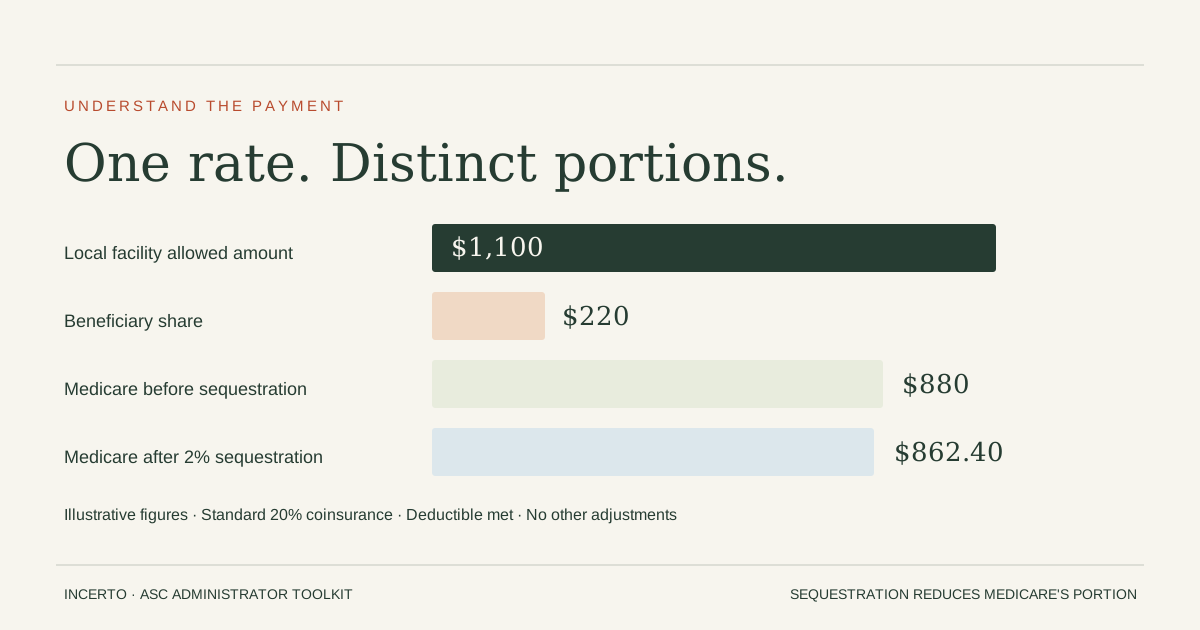
Figure: Incerto's invented amounts and arithmetic. Policy assumptions: Medicare.gov's standard ASC cost sharing and CMS's sequestration calculation order, page 4. This is not a published procedure rate or patient estimate.
In this example, Medicare's post-sequestration portion plus the stated beneficiary portion totals $1,082.40. That is a modeled payment total. Whether and when the center collects the beneficiary amount is a separate question.
Applying 2% to the full $1,100 would incorrectly reduce the modeled total by $22 rather than $17.60. Adding that difference to the patient balance would compound the mistake.
Why 20% is an assumption, not a patient quote
The standard share has exceptions. Medicare.gov's ASC costs page identifies preventive-service exceptions, and CMS describes reduced beneficiary coinsurance for certain Part B drugs and biologicals in the Medicare Inflation Rebate Program, “Coinsurance Adjustment for Part B Rebatable Drugs”.
Medicare.gov notes that actual costs depend on coverage, other insurance, and the provider and setting. Medicare.gov ASC guidance, “Costs”. We recommend a patient-specific benefits and coverage review before communicating an estimate, separate from this general rate comparison.
Write the assumption beside any calculation that uses 20%. For a nonstandard beneficiary percentage, subtract the applicable beneficiary amount first, then apply sequestration to Medicare's calculated portion. Do not hard-code a universal 80/20 split into every row of an annual model.
Explain packaged services and multiple procedures
A packaged item's cost is included in another payment, rather than paid separately. CMS Claims Processing Manual, Chapter 14, §10.2. Our recommendation is to keep that status distinct from a missing input, excluded service, or actual claim denial.
Multiple-procedure and device-credit rules can alter payment. CMS Claims Processing Manual, Chapter 14, §§40.5 and 40.8. A sum of full standalone rates therefore does not establish the payable amount for an encounter.
For our rate-change worksheet, we recommend counting eligible standalone primary procedures within its stated scope. For a disputed payment, review the actual remittance and applicable claim rules with your billing team and Medicare Administrative Contractor. We do not assess whether a particular claim was underpaid or should be appealed.
For related Incerto commentary on operational review, see receivable age and recovery priorities and our ASC administrator workflow article. These are related reading, not Medicare-policy sources.
Keep the payment release with the calculation
The budget workspace provides fields for 2026 Q4 and the 2027 final rule, our selected comparison periods. Enter rates from those releases yourself after verifying their payment basis. ASCA says official 2027 first-quarter rates will be published in January payment addenda around January 1, 2027. ASCA public payment-resources page, “2027 Final Rule Rate Calculator”. Check the January release for changes before using final-rule figures for billing.
Keep the release, location, method, beneficiary-share assumption, and sequestration treatment attached to the number you share. Then open the Medicare ASC budget workspace for official source links and a worksheet for your own verified rates and volumes. The workspace does not retrieve rates or calculate patient-specific payments. The budget impact guide shows how to extend a consistent rate comparison across annual volumes.
Sources and scope
Public payment-policy sources are linked beside the statements, formulas, and figures they support. CMS and Medicare.gov provide the primary policy explanations; Noridian is a Medicare Administrative Contractor publishing its own FFS guidance, and ASCA provides its own release guidance. Sources were checked November 15, 2026 and may subsequently change.
All example dollar amounts and the sample wage-index value are Incerto's invented inputs and arithmetic. The 20% and 2% policy assumptions have their public sources linked above. The formula notation, decision table, and workflow recommendations are our explanation, not official instructions. Examples exclude patient-specific coverage, benefits, claim edits, and payment-method exceptions. Internal articles are related reading, not policy evidence.
Educational reference only. Incerto provides this resource as is, without warranties of accuracy, completeness, currency, or fitness for a particular purpose. It is not medical, legal, billing, coding, or financial advice, an official CMS or ASCA publication, or a guarantee of coverage or payment. Examples are invented; worksheet results depend on user-entered inputs that Incerto does not verify. Verify the current CMS release and applicable Medicare Administrative Contractor guidance before billing, patient estimates, or financial decisions. To the extent permitted by law, Incerto disclaims liability for losses arising from use of this resource. Source links do not imply endorsement.