
My question to MGAs
If renewal retention is what compounds your book year over year, then:
Why is 15% of your revenue still walking out every cycle?
Renewal decisions aren't made when the notice arrives. They're made weeks earlier, when a client quietly starts questioning whether their price still reflects their clean loss history, whether their coverage has kept up with their business, or whether the service they've received justifies staying.
Do you actually know why you don't keep up with other metrics, or are you defaulting to pricing because that's the only signal you see?
If your data isn't keeping up with that decision window, you're not managing retention but you're reacting to loss after it's already happened.
Pain points I understand
The process starts with no real signal. The renewal window opens ~90 days before expiry, and the system generates a notice saying updated premium with basic account details. That's it. Everything else that actually matters for retention has to be pulled manually.
Renewal notice arrives with a number on it. No context on which accounts are price sensitive, just a number.
Assembling that picture takes 8 to 12 hours per account cycle. By the time someone actually thinks about the account, the decision window is already closing.
The insurer finds out a policy has been lost when the renewal premium doesn't arrive. By then it's already gone.
Fragmented data slows everything down, forcing MGAs to stitch together insights manually instead of acting early.
When agents receive no context at renewal and that too so late all they have left to pitch is price. And price rarely wins.
And for MGAs, the downside is compounded. They don't own the paper. Every lost renewal isn't just commission but a weaker book in front of the capacity provider. Enough of those, and binding authority is at risk.
Revenue lens
When I look at renewal retention through a revenue lens, what surprises me isn't just inefficiency it's how quietly it translates into real loss.
A $50M book losing 15% every cycle is losing $7.5M annually. A $200M book, $30M. Not from bad underwriting. Not from poor pricing. From accounts that simply weren't engaged early enough.
In an industry this mature, this still happens at scale. Not because the data doesn't exist but because it doesn't show up when it matters.
A 3 point improvement in retention on a $200M book preserves around $6M in annual premium.
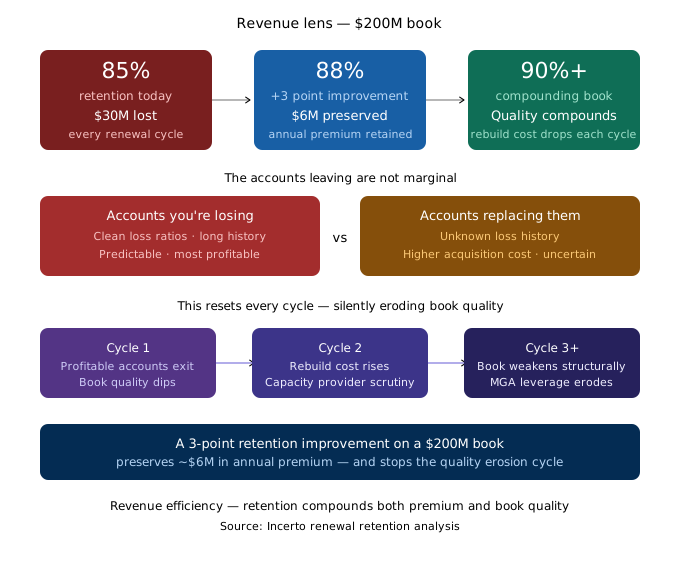
Retained accounts don't stay flat but they grow revenue. Higher limits, broader coverage, more lines over time. The $6M in year one compounds quietly in the years after.
The part that's often missed is who is leaving. It's not the marginal accounts. It's the ones with history, clean loss ratios, predictable behavior; the ones that actually make the book profitable.
The accounts you're losing are your most profitable. The ones replacing them are your most expensive.
And that's where the real cost compounds. Because this isn't a one-time leak. It resets every renewal cycle, quietly eroding the quality of the book while increasing the cost to rebuild it.
Incerto's potential
For me, renewal retention doesn't just protect revenue it preserves the relationships that define an MGA's book. Capturing this isn't optional.
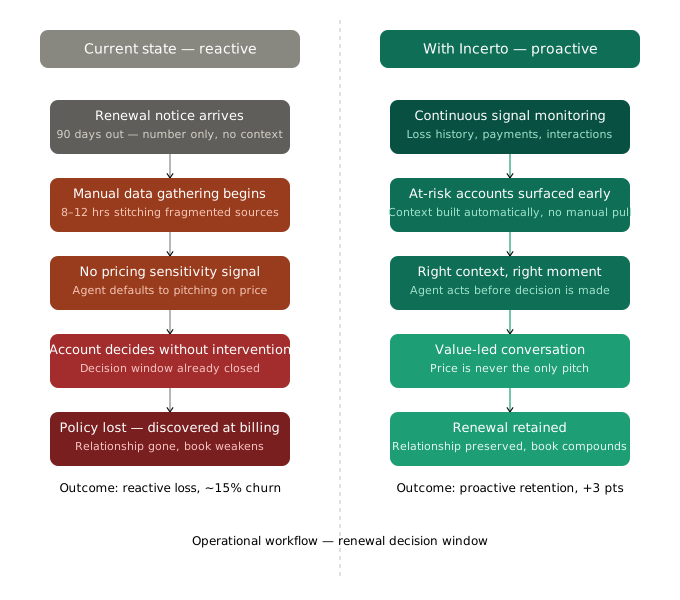
With Incerto, the assembly work is already done: price sensitive accounts are flagged, service gaps are surfaced, and premium increases are cross-referenced against loss history so MGAs can act on every renewal without gathering any data manually.