

My unplanned conversation
I have been wandering across tech and insurance meet ups and on April 2nd during a meet up, I heard someone at the adjacent table go on a full rant about how messy claims triage workflows are.
The founder in me could not help but go up and ask more. He turned out to be a carrier-side operator who admires technology in insurance, but was frustrated with how loosely "AI" gets thrown around without fixing real problems.
Coming from a place where building in AI is the default, it was surprising to hear resistance like this.
Problems I got to know
He described how even with everything visible across systems, nothing feels ready when it comes to start a claim triage. Even with various AI tools and systems, it is still required to manually pull all the context needed for claim triage.
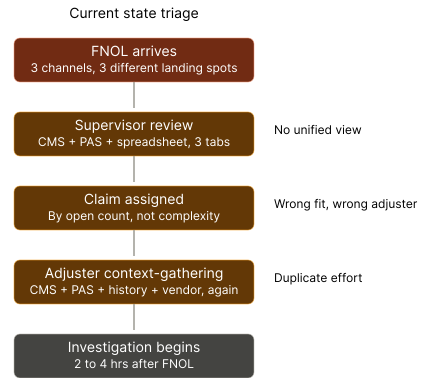
A FNOL comes in, and before anyone even starts workinge the claim, two hours are already gone just pulling context together from scattered systems.
The delay is not in the work. It is in getting the claim ready to begin work.
Claims come from calls, portals, emails. Each lands differently, so the same claim starts in three different places with no single view.
The problem starts at intake, not because of volume, but because context comes from various sources, which means claims are fragmented right from the start.
Supervisor checks CMS, PAS, spreadsheets to assign it. Then the adjuster repeats the exact same process. Same context, rebuilt twice.
The inefficiency isn't accidental it's built into the workflow, due to which same work happens more than once.
This conversation made it clear to me, what insurance needs isn't more surface level tools, but something solid that actually supports claims to move revenue forward.
Numbers we mapped
We started mapping the numbers in our heads to see what this actually looks revenue wise.
When you're handling ~50,000 claims a year, spending 2 to 4 hours per claim just getting it ready adds up to $6M to $12M annually before any real work even starts.
This whole work is done for just preparing the claim, not for handling it.
Even recovering 30 minutes per claim puts $1.5M back in year one without touching headcount or volume.
The opportunity sits inside something that happens on every single claim.
Triage delays don't just waste hours; they push claims to stay open longer. A 2 to 3 day reduction alone translates to another $500K to $1.5M recovered annually.
Small delays at the start compound across thousands of claims. Time lost is money lost.
Where Incerto fits in
The more I mapped the workflow, it became clearer Incerto's agents are built for such problems.
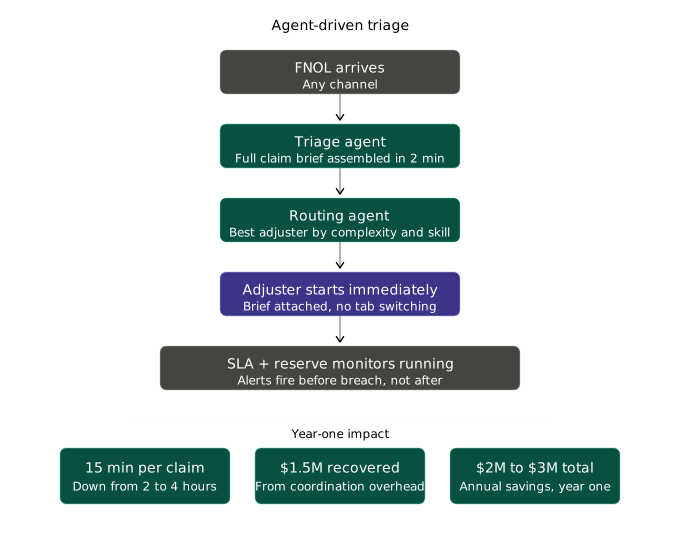
You no longer have to pull data from CMS, PAS, emails, and portals or piece everything together before starting. Incerto’s agents handle that in the background, bringing everything into a single view and preparing the claim so assignment and handling can begin immediately.
That is where Incerto fits, to save numbers on both time and money.