

I've been talking to bankers lately, trying to understand how they work. Some conversations are quite insightful, such that you write a blog about it. This was one of those conversations.
The problem I got to know
Last week, a Managing Director at a mid-market investment bank told me something that reframed everything I thought I knew about deal origination.
He is very good at his job. Two decades in. Closes 3–4 mandates a year, each worth $1.5–2M in fees. I asked him one simple question:
How do you know when a company in your coverage is about to need an advisor?
He paused. Then said:
I don't. I find out when everyone else does.
I couldn't stop thinking about that.
Who he is
He tracks 80–150 companies. Knows the CEOs, the CFOs, has done deals with some of them. He has a team. There are analysts. There are many tools too.
And still, the signal that a company is about to need an advisor reaches him the same time it reaches everyone else. The first call goes to whoever happened to be in the room last week.
One missed mandate is $2M gone. Two is his entire year.
The problem
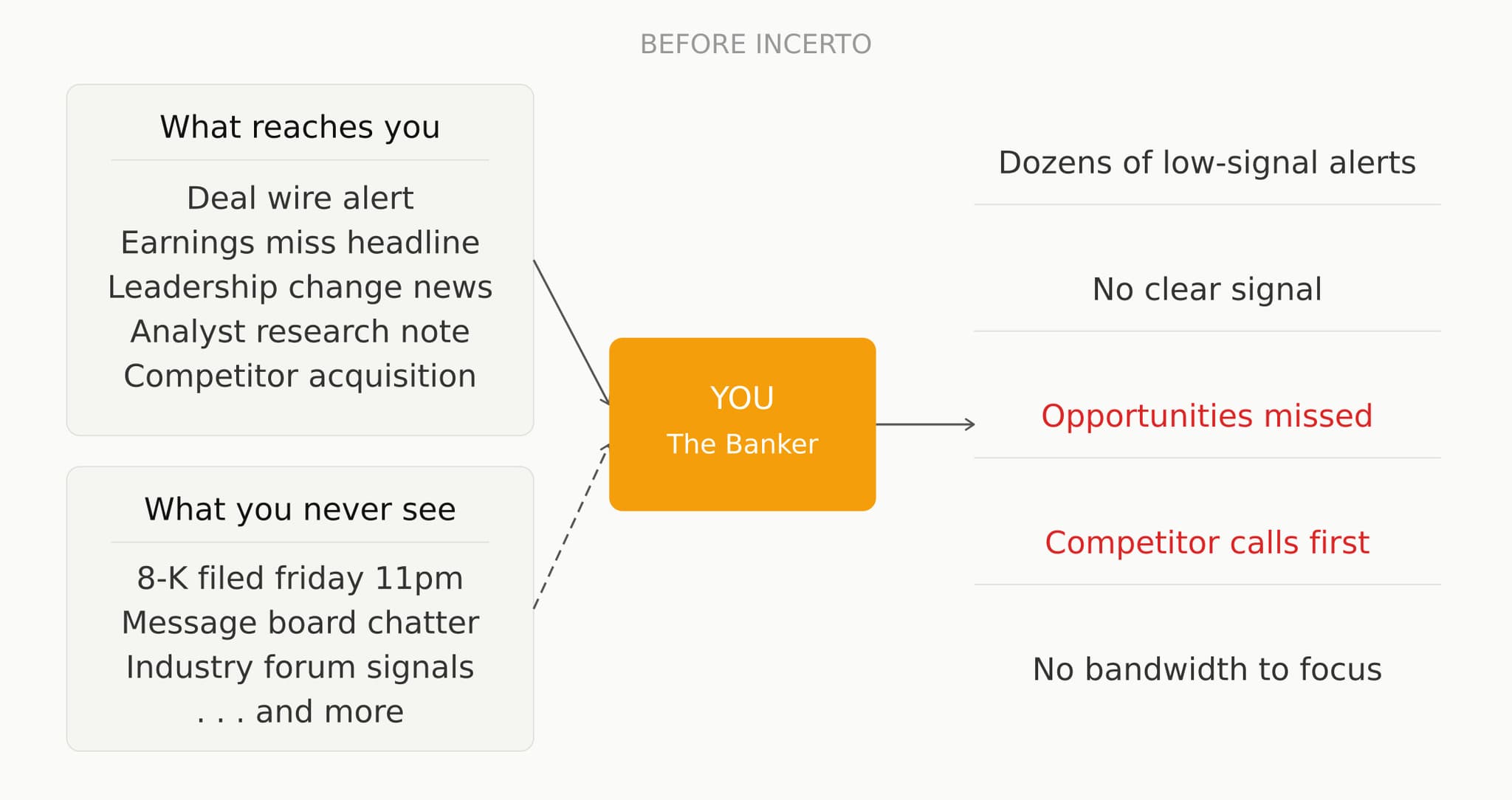
A banker's job is to be in front of the right company at the right moment. Not when a deal is announced, but 60 to 90 days before, when a company is quietly heading toward a decision and hasn't yet picked up the phone.
The signals are out there. A CFO departure. A debt maturity in a 10-K. A competitor acquired. A hiring freeze. All public. All findable. All real.
But it isn't just that nobody is watching. It's that even when bankers are watching, with tools and analysts, what they get is dozens of low signal alerts a day and not 5 good ones.
Tools like PitchBook, AlphaSense, Eikon are good in their lane but they are silos. Someone still needs to actively, 24/7, and intelligently, with the banker's own input and feedback, look across all of them, stitch the signals together, and surface the one that matters today.
This company. This person. Now. Here's the angle. Here's why.
That insight is still entirely dependent on humans, gut instinct, and manual effort. Every single day.
And the harder part: every banker is different. The filters, the theses, the sectors are all unique. Any system that doesn't understand this will just add to the noise.
What we are building
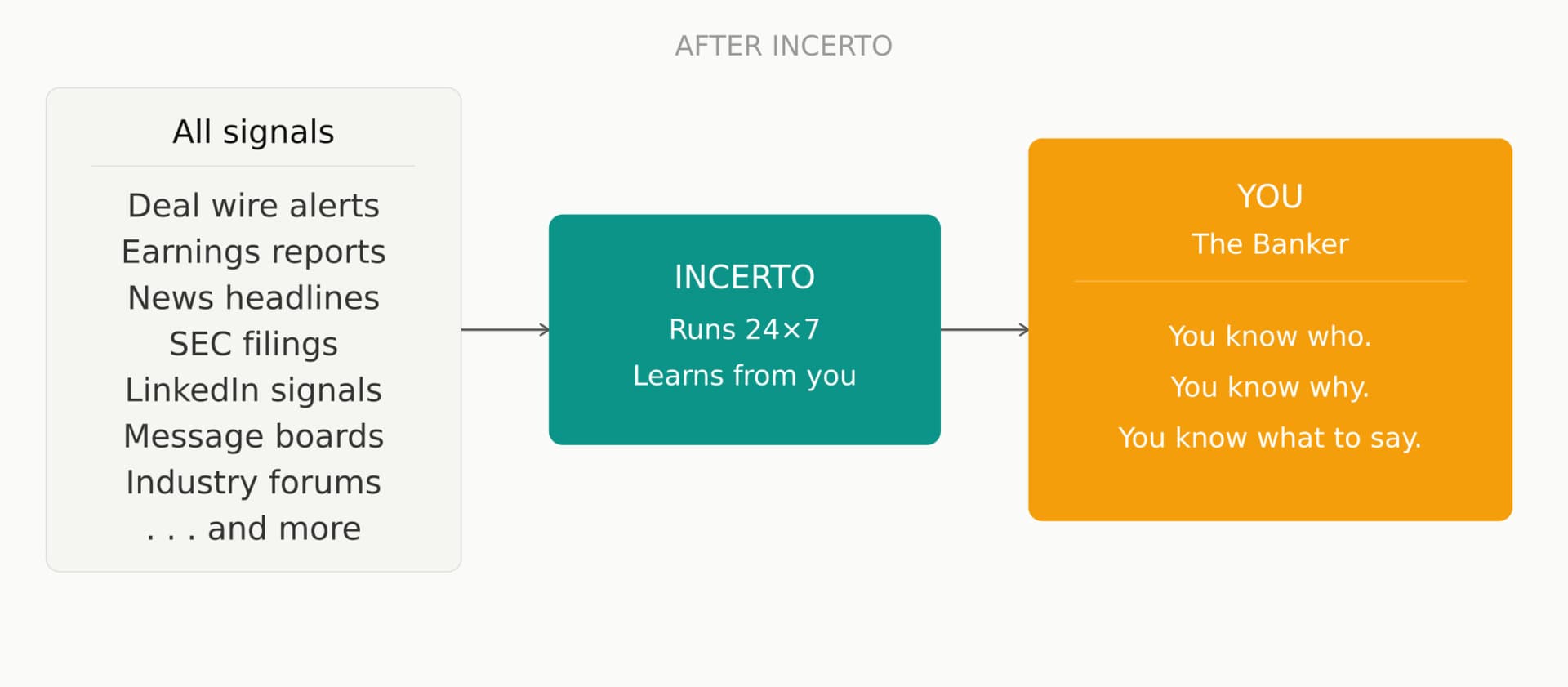
Here is what we think should exist for bankers:
You define your universe, 80 companies in your sector. A team of agents monitors all 80, around the clock, across SEC filings, news, LinkedIn, social signals, and message boards.
Every morning, when you wake up: This company. This person. Now. Here's the angle. Here's why. The system does the watching. You do the talking.
It runs as agents working in parallel, not a single bot, not a one time query. While you sleep, they are reading, scanning, cross referencing, and building a picture. When something converges into a real opportunity, they surface it. When they need context, or when two signals point in different directions and a human call is needed, they ask you, in the moment.
And every interaction adds up. Once the parameters are defined, every approval, every rejection, every piece of feedback tightens the system's understanding of what matters to you. The results keep getting better. It is not trying to be a generic tool for all bankers. It is trying to become the right tool for this banker, this sector, this moment.
What I don't know yet
I'm a founder, not a banker. I've spoken to a handful of people in this world, not hundreds. I could be wrong about a lot of this.
Maybe this is already solved somewhere I haven't looked. Maybe one of these tools does this and I've missed it. Maybe the approach is right but the execution I'm describing is off.
What I do know is that the banker I spoke to last week described this gap with a frustration that didn't feel like an edge case. Two MDs. Different firms. Same answer. I think something is missing and Incerto is going to build for it.