
Recently, I've been going deep on subrogation specifically, to understand where the revenue cracks and how insurance teams handle it. Along the way, I've been talking to people who've lived inside this problem for years. One conversation in particular made me question a lot of assumptions I had going in.
So I'm writing this down.
Because if you're in insurance and you're not asking whether your subrogation cases are being identified and not just recovered then you're likely leaving more on the table than you realise.
Where I got the real answer
When I started digging into this, I needed someone who had actually lived inside these workflows. Giuliana was an easy reach; she's spent years in insurance finance and has seen how MGAs think about recovery from the inside.
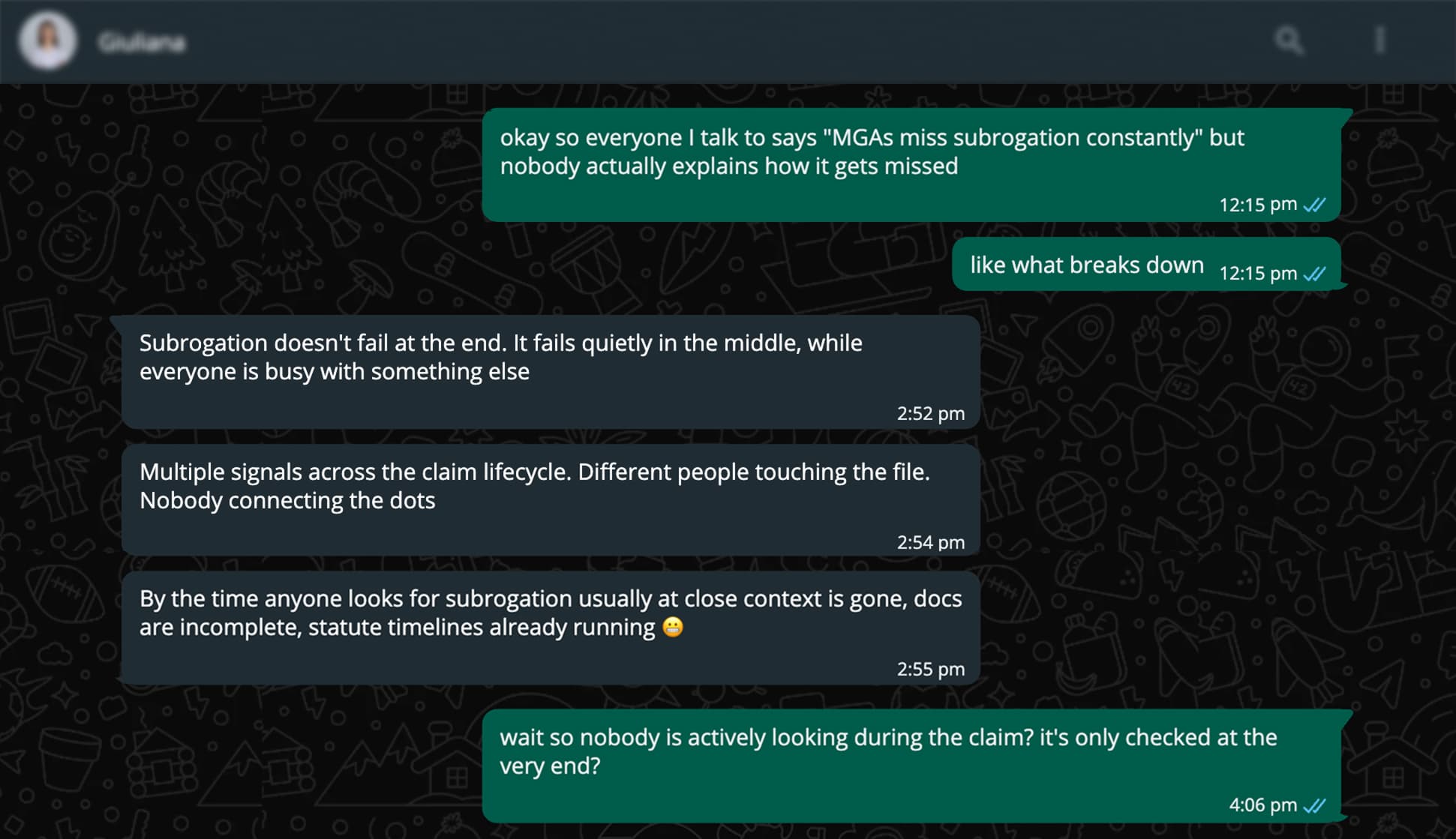
Subrogation doesn't fail at the end. It fails quietly in the middle, while everyone is busy with something else. Multiple signals live across the claim lifecycle. Different people touching the file. Nobody connected the dots.
The FNOL comes in, liability signals are incomplete. The adjuster is managing 80 to 150 files, so subrogation becomes a "come back to this." New information arrives, repair notes, police reports, third party mentions and nothing re-triggers a review. By the time the claim closes, context is fragmented, docs are incomplete, and statute timelines are already running.
"Every adjuster has a mental pile called 'I'll come back to this.' Subrogation lives in that pile."
And they never come back.
Some maths we did
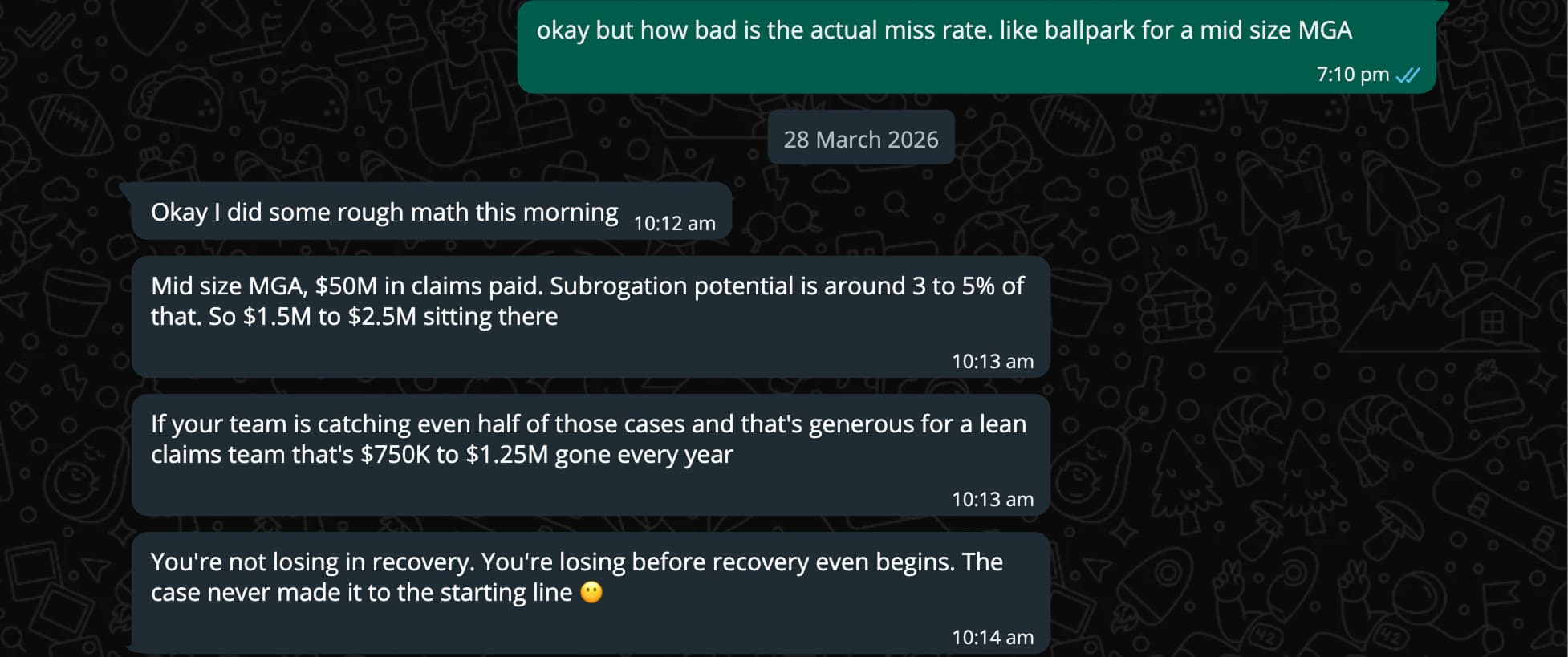
I asked Giuliana to put a number to it. She came back the next morning with this:
So let's make it concrete.
A mid-sized carrier reports around 4,000 claims a month. Of those, roughly 120 to 160 have real subrogation potential about 3 to 4%. Half of those are obvious early. The other half only become identifiable as more information comes in reports, liability updates, third party details surfacing mid-claim.
In most setups, only about 50% ever get flagged. The rest are either never identified, caught too late, or lack enough context to act on. That's 50 to 80 valid recoveries missed in a single month.
You're not losing in recovery. You're losing before recovery even begins. The case never made it to the starting line.
And because this sits directly in losses, even a $1M recovery improvement flows straight into combined ratio improvement.
What I didn't expect: MGAs can't escape this
When I asked Giuliana whether this compounds over time, her answer was immediate "more than people realise." And then she said something that reframed the damage entirely.
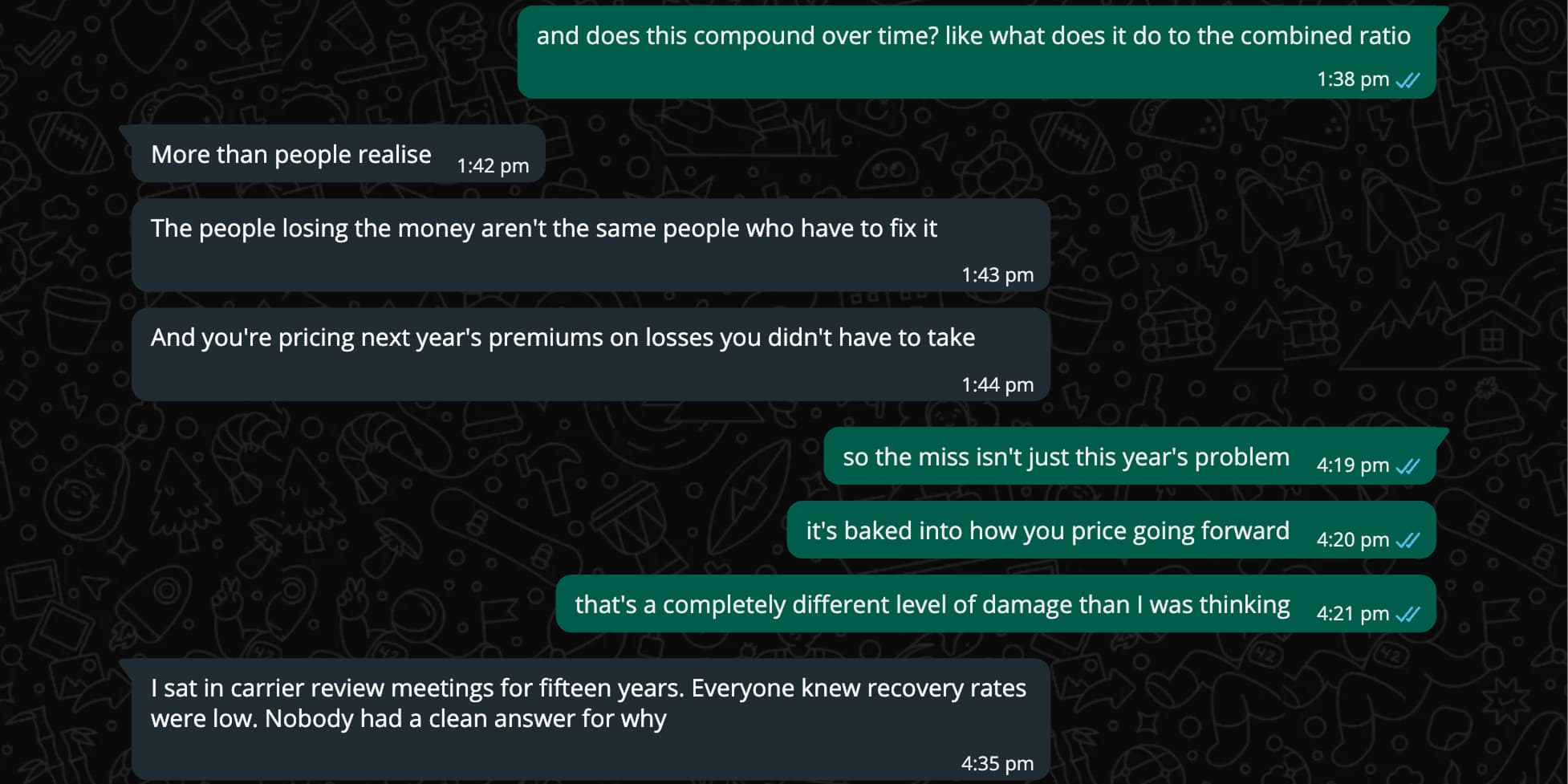
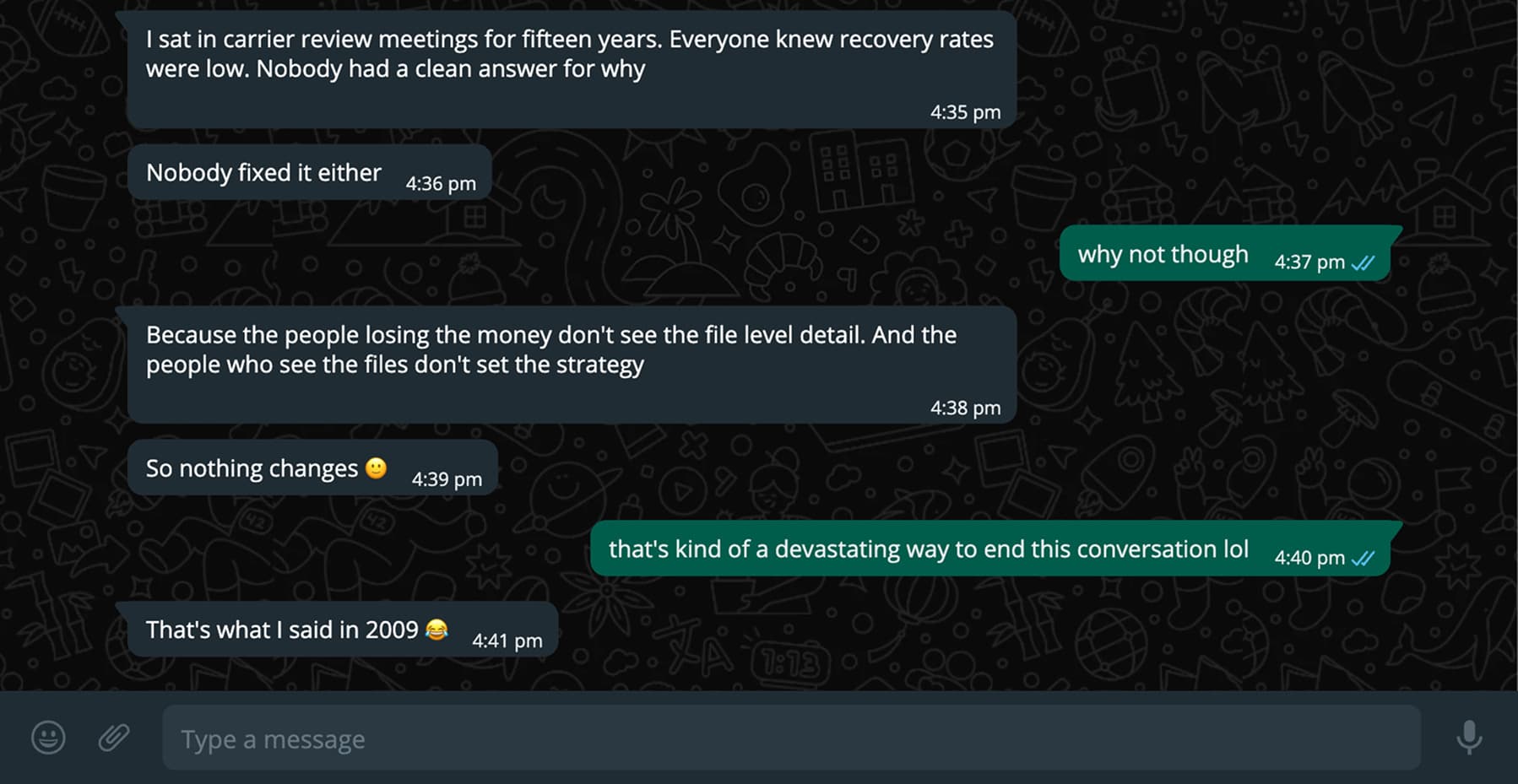
The people losing the money aren't the same people who have to fix it. And you're pricing next year's premiums on losses you didn't have to take.
Every missed subrogation case gets absorbed into your loss figures, which then shape how you price the next cycle. The miss is baked into your combined ratio, and then baked into your premiums. Everyone knows recovery rates were low, but why nobody has a clean answer. The people who see the files don't set the strategy. So nothing changes.
What am I here for?
What stuck with me most wasn't the numbers. It was Giuliana's closing line "that's what I said in 2009." A problem this well understood, still sitting there unfixed seventeen years later.
I'm not coming into insurance with decades of claims experience. What I have is curiosity about why an industry this large keeps losing revenue on what is fundamentally an information problem.
That's what Incerto is here to work on. Long running agents, organizational context, continuous monitoring across the claim lifecycle. I'm still figuring out exactly what the full answer looks like.
But the question is worth asking loudly. And if you're reading this, maybe you're asking it too.