

The surgeon's office says the case is authorized. The surgery center has an approval number in the chart. A week later, the facility claim has a problem. Who confirmed that the approval covered the ASC facility, the scheduled procedure, and the actual site of service?
That is the operational question behind ASC prior authorization responsibilities. A single case can involve a surgeon, an ASC, an anesthesia group, and different claims. The office that submits the request and the entity whose services are covered by the decision are not automatically the same. A good handoff makes those details visible before the case reaches the schedule.
The question to close: Who checked that the payer's decision covers this facility, this procedure, and this date? An approval number alone does not answer it.
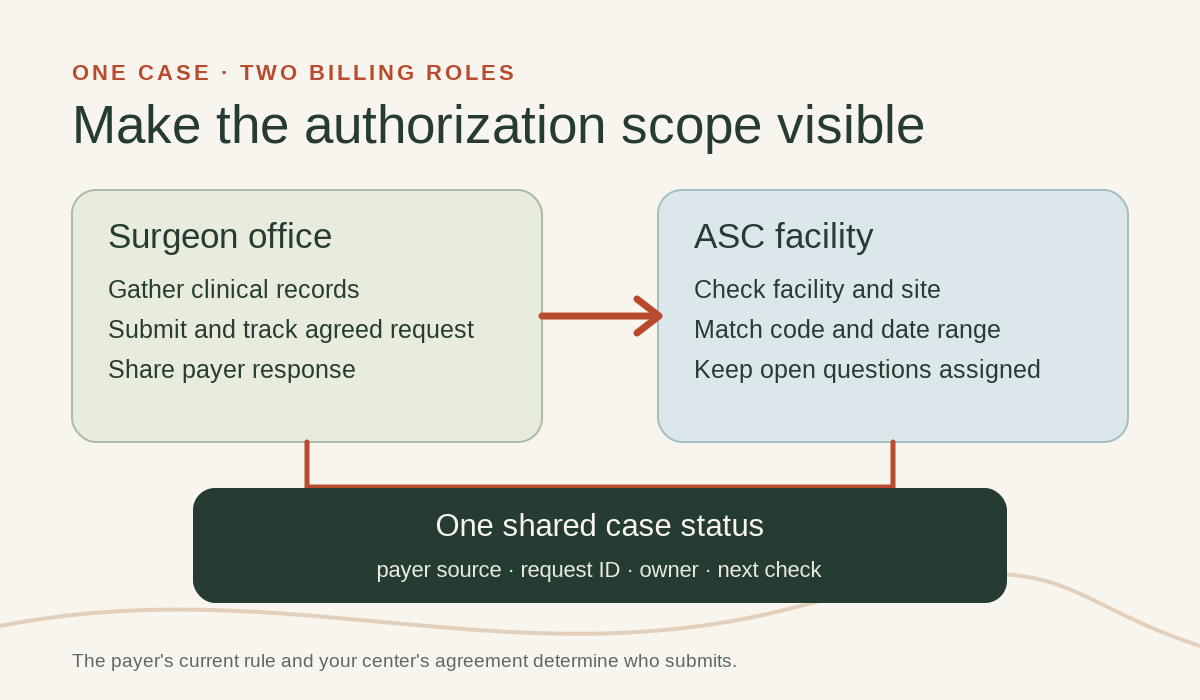
A practical division of work. The payer's rules and the center's agreement decide who actually submits each request.
Separate the case from the claims
Start with a simple case map: patient and plan, planned procedure, surgeon, facility, anesthesia arrangement, anticipated date, and the claims each participant expects to submit. The map does not decide payer policy. It gives the team a way to ask the payer the right question.
Medicare's ASC payment rules distinguish the facility payment from physician professional services. That distinction does not prove a commercial plan requires two authorization numbers; it explains why the center should confirm the scope of any approval instead of assuming that a surgeon-office confirmation settles the facility claim. CMS Claims Processing Manual, Chapter 14.
For each relevant plan and product, record whether authorization is needed for the procedure, the facility site, the professional service, or a combination. Ask whether one decision covers multiple billing entities and how each claim should reference it. If the payer's portal or response is unclear, flag that as an open question with an owner, rather than checking a generic “authorized” box.
Put responsibility in writing before the first request
An ASC and a surgeon's office may agree that the office obtains clinical documentation and submits requests, while the facility verifies that its own site and identifiers are covered. Another center may submit the facility request itself. Either workflow can work when the payer accepts it and the handoff is explicit.
For each surgeon-office relationship, write down:
| Step | Named owner | Evidence to hand over |
|---|---|---|
| Confirm plan and product | Scheduler or financial-clearance team | Member details, date checked, payer channel |
| Check whether authorization is required | Assigned requester | Policy or payer response for the planned code and site |
| Gather clinical records | Surgeon office or agreed clinical owner | Document list and request date |
| Submit and follow up | Agreed requester | Request ID, status, next action, due date |
| Verify facility scope | ASC financial-clearance owner | Facility name or identifier, site, code, date range, decision |
| Recheck after case changes | Owner of the schedule change | Updated code, site, date, and payer confirmation |
This is an operational template, not a statement that every payer requires every field. The payer's current rules and the center's agreement determine the actual work.
Treat approval as a scoped decision
When an approval arrives, read the details against the scheduled case. A useful review asks: Does the decision identify the correct member and plan? Does it cover the scheduled procedure and service location? Are the effective dates right? Is the ASC named or otherwise covered where required? Is the decision final, or is a clinical document still pending? Record the source, not just the number.
An approval may also need a fresh check if the surgeon changes the procedure, the case moves to a different facility, or coverage changes before surgery. Keep those events in the shared worklist. The point is to prevent a future authorization mismatch, not to promise that any approval guarantees payment. Coverage, coding, medical necessity, and claim submission still matter. Aetna's precertification guidance for health care professionals illustrates that requirements depend on the procedure and plan; verify the member's specific product rather than applying a general rule.
Do not confuse one Medicare program with every payer
CMS currently has a voluntary prior authorization demonstration for certain Medicare fee-for-service ASC services in selected states. It names ASC facilities as the submitting providers and covers a limited set of service categories. Its scope and workflow should not be generalized to Medicare Advantage or commercial plans. CMS ASC prior authorization demonstration.
That distinction matters because staff often have a mixed schedule. Put the payer program and product beside every authorization task. The same procedure code can require different checks depending on who insures the patient and where the service will be performed.
Make the unresolved case visible before surgery
At a daily schedule huddle, filter upcoming cases to those without a confirmed decision or with a scope question still open. Each should have a named next action and cutoff for escalation. “Office is working on it” leaves the facility guessing. “Office sent records Tuesday; payer request 123 is pending; Maria will call Thursday and confirm ASC site” gives the team a usable status.
The center can measure whether this process works: percentage of scheduled cases with an authorization requirement checked, percentage with facility scope confirmed, days between request and decision, cases changed after approval, and authorization-related delays or denials. Keep the denominator as all cases that required a check, not just the cases that produced a problem.
Run the check on one upcoming case
Use one case on next week's schedule to see whether the handoff works in practice:
- Name the plan product and proposed service. Record the procedure, site, facility identifier, surgeon, and expected date. Do not rely on the patient's insurance company name alone.
- Find the payer's actual requirement. Save the policy, portal result, or representative response used for this case. Mark unanswered scope questions as open.
- Trace the request. Who submitted it, what documents were sent, what request ID came back, and who owns follow-up?
- Read the decision against the schedule. Compare the covered service, site, dates, and billing entities where the payer specifies them. Save the source of the answer.
- Assign a recheck trigger. A changed code, site, date, or plan should reopen the question under the center's process.
If step four cannot be answered, the case is not “facility scope confirmed.” It is a case with a named follow-up task. That one distinction makes the schedule huddle more useful than a column of green approval numbers.
If your team is rebuilding this handoff, start with the prior authorization denial guide and the broader ASC billing workflow. For a practical next step, map your current authorization follow-up process against one upcoming case and ask which approval details your center can actually see.