

The pre-admission testing (PAT) call is over, but the chart still has work in it. The patient could not name a medication. The surgeon's office has not sent a requested record. The nurse needs anesthesia to review one answer. A pre-admission testing handoff should make all three items visible to the next person, with a deadline before surgery.
A call log or a completed questionnaire does not tell the schedule team whether those items are closed. The handoff needs to carry evidence, decisions, and ownership through to the chart.
A useful PAT handoff answers four questions: What is the source? What remains open? Who owns the next action? What evidence will show it is closed?
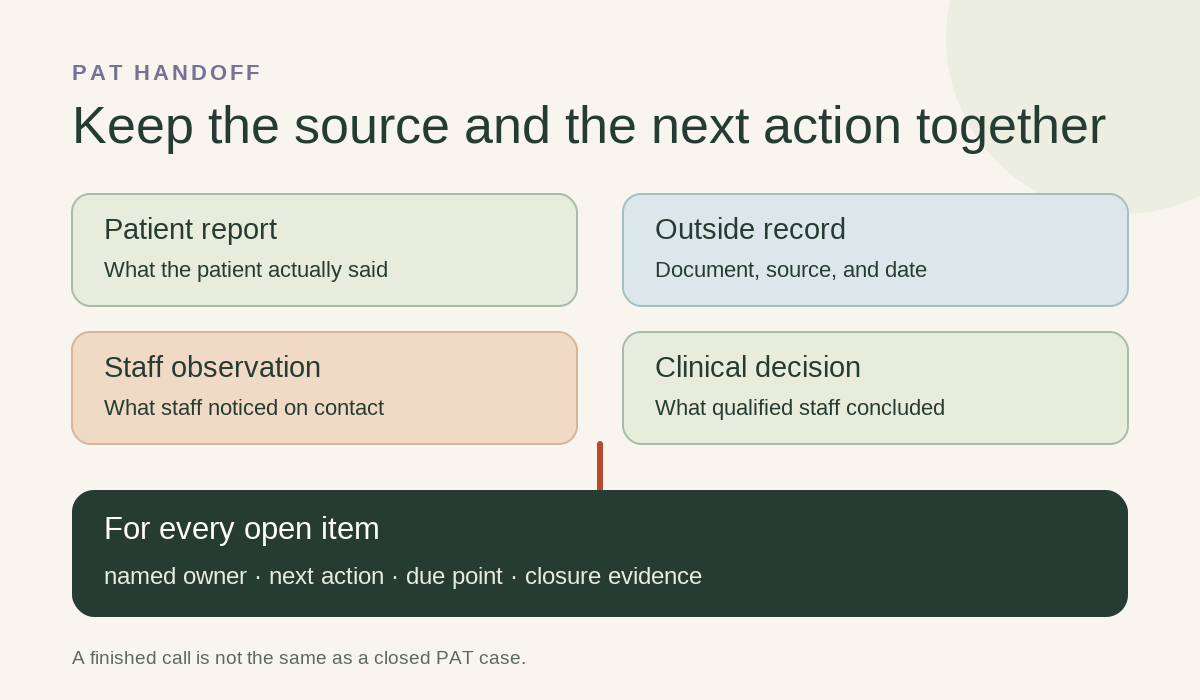
A call can be finished while the case still has open clinical or document work.
Start with four different kinds of information
Put each item in the right column:
- Patient report: what the patient said, in their words when nuance matters.
- Record evidence: what is present in an outside document or chart, with its source and date.
- Staff observation: what a nurse or other staff member noticed during the contact.
- Clinical decision: what an authorized clinician concluded and documented.
Those are not interchangeable. “Patient says no prior anesthesia problem” is different from “anesthesia review completed.” A record that conflicts with the patient's answer should stay visible until someone resolves it. The incomplete-history guide covers the common states that a yes/no form can hide.
Give every open item an owner and a due point
For each unresolved item, the handoff should include the original question, current status, responsible person or team, next action, and the point at which it must be escalated. “Needs follow-up” is a label; “PAT nurse will obtain the outside record by Wednesday and send it for anesthesia review” is a plan.
An illustrative handoff might read: “Patient could not confirm medication name during Tuesday call. Patient will call back with the bottle; PAT nurse owns the callback by Wednesday noon. If the information is still missing, route the case to the clinical reviewer under center policy.” That tells the next person what happened, what has not happened, and who owns the next move. It does not suggest a clinical decision about the medication.
Use a simple case-level closure checklist:
| Check | Evidence the next person should see |
|---|---|
| Patient contact | Date, channel, completed or partial status, callback plan |
| History | Patient responses and any uncertain or conflicting details |
| Outside records | Requested, received, reviewed, or still missing |
| Clinical questions | Assigned reviewer, status, documented answer or escalation |
| Preparation and logistics | Center-approved instructions delivered, unanswered questions, escort plan |
| Schedule disposition | Open items, owner, cutoff, and who can decide whether to proceed |
This is an operational checklist. It is not a substitute for the center's clinical protocol or required documentation. CMS's ASC survey guidance requires appropriate pre-surgical assessments and the H&P, if required by the ASC's policy, to be in the record before surgery. The center's qualified staff remain responsible for assessment and decisions. CMS ASC State Operations Manual, Appendix L.
Close the loop when information changes
PAT is not finished the moment the call ends. The surgeon's office might send a new record, the patient might call back with the medication name, or the procedure may change. The handoff needs a way to show the new fact, who reviewed it, and whether a prior decision needs another look. Avoid overwriting the original patient answer; keep the trail that explains why the team acted.
For a mixed-specialty center, a shared worklist can be more useful than separate email threads. One case might need a nurse callback, another a scheduler's record request, and a third a financial-clearance check. Each should have its own owner. A dashboard can summarize the status, but staff should be able to open the underlying response and source.
Review tomorrow's cases by exception
At the schedule huddle, ask three questions for each case with open work: What is unresolved? Who can resolve it? What happens if it is still open at the cutoff? This does not let non-clinical staff decide clinical readiness. It makes sure the question reaches the right person while the schedule can still change.
Make the huddle output explicit: one person owns the next contact or record request; one qualified reviewer owns any clinical interpretation; and the schedule team can see the center's escalation point. If the item arrives after the huddle, retain the original source and record who reviewed the new information. An arriving document is not the same as a completed review.
Track a few measures across all scheduled cases: percentage with a completed PAT contact, percentage with nurse review, open items per case, time to close an item, late record arrivals, and cases whose issue first surfaced on surgery day. Measure correction time too. A faster first call that creates more nurse rework may not save capacity. The pre-op nurse workload article shows how to count the full case effort.
If you want to redesign this process, use the PAT workflow map to mark your current handoffs. Then inspect Incerto's fictional nurse review queue and compare it with the evidence your team needs before it can close an item.