

A patient has a voicemail asking them to arrive at 9 a.m. Tomorrow’s case order changes, and the ambulatory surgery center (ASC) now needs them there at 7:30. Both times are on the patient’s phone. Which one are they planning around?
When your ASC changes an arrival time, have one designated team confirm the revised time in the schedule, tell the patient which instruction it replaces, and record whether they acknowledged it. If you cannot reach them, leave a named owner and next attempt by the center’s cutoff.
Set one place to verify the current time
St. Petersburg Endoscopy Center’s FAQ tells patients to use the arrival time the center confirms, which may differ from the time the physician’s office originally gave. Decide who has that authority at your center and how the other people calling the patient can look up the current answer. St. Petersburg Endoscopy patient FAQ
Keep arrival time separate from procedure time in the schedule and in the message the patient receives. When the change is approved, preserve a record of the prior instruction and when it was sent. Update or retire pending reminders where the system allows. Tell affected teams how to recognize superseded instructions if a message has already gone out.
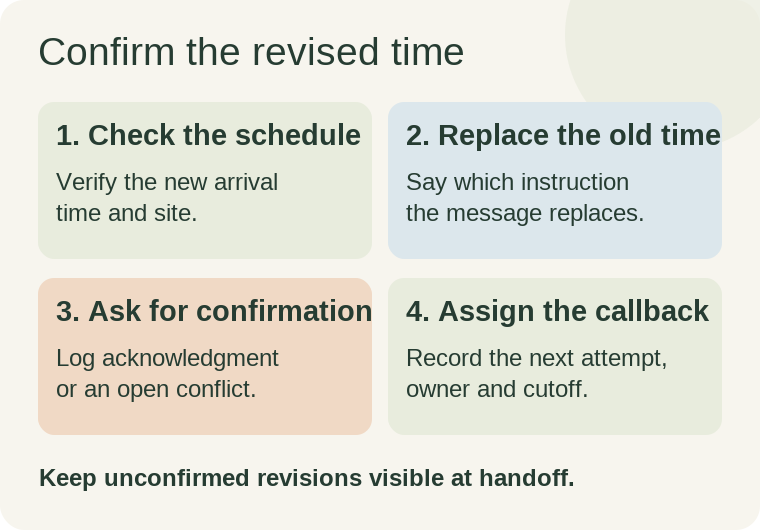
Use a callback checklist when a time changes
| Step | What to record |
|---|---|
| Confirm the revision | Date, site, authoritative arrival time, and who approved the change |
| Replace the earlier instruction | The older time that the revised message supersedes |
| Confirm the plan | Patient acknowledgment, a conflict, or a question needing another team |
| Keep unconfirmed cases open | Approved retry channel, assigned owner, and cutoff |
In the fictional 7:30 example, staff can say after verifying the recipient through the center’s normal process: “For tomorrow, please plan to arrive at 7:30 a.m. That replaces the 9 a.m. time in our earlier message. Does that still work for you and the person bringing you?” If the new timing affects a preparation question, get it to the responsible clinical staff using the center’s approved process.
Give the next shift a useful status
Use statuses that identify what the next person needs to do. A delivery receipt shows that a message was sent or delivered. A patient acknowledgment confirms they heard the change. A patient who understood it but cannot arrange transport still has an open issue.
At the cutoff, ask which changed cases still lack acknowledgment, who owns each one, and which earlier messages might still cause confusion. Compare the time from schedule change to patient acknowledgment on your next ten revisions. That makes the problem easier to isolate than counting every outbound call together.
This checklist covers a revision after a first contact. For the earlier outreach plan, see when ASCs should call patients before surgery. For cases still open after an attempt, use the guide to unanswered pre-op calls.