

Calling every patient the afternoon before surgery gives the team a current answer, but it gives them little time to obtain an outside record, settle a preparation question, or arrange a ride home. Calling everyone two weeks out creates another problem: plans can change. When should an ASC call patients before surgery? The useful answer depends on what the call is meant to accomplish.
Think in two passes: gather information early enough to act, then confirm the details that can change close to the procedure. Your center's approved protocol should set the actual timing and instructions for each type of case.
Choose the first call by the work it might uncover. A call made in time to request a record or route a clinical question has a different job from a final arrival reminder.
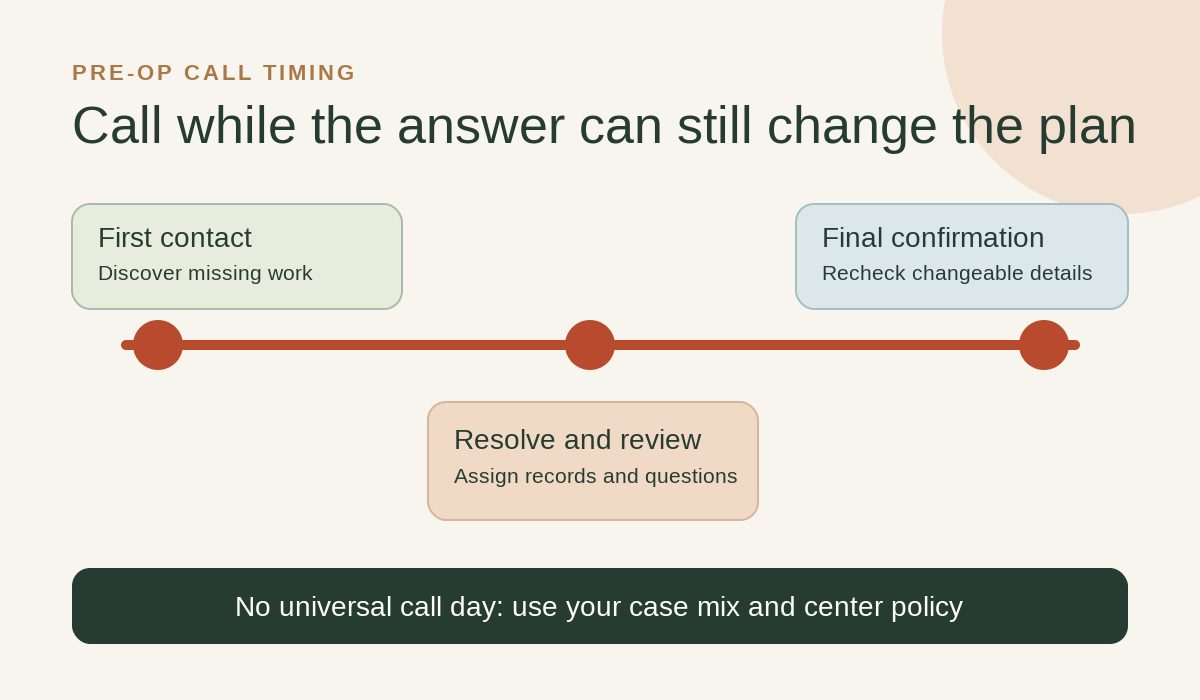
The sequence is a planning pattern, not a universal number of days before surgery.
Put the first contact where it can change the plan
An early screening contact is valuable when it can surface missing history, outside records, anesthesia questions, unconfirmed transportation, or patient confusion with enough time for the responsible team to respond. The first contact need not settle every issue. It should expose the work and assign it.
One published University of North Carolina ASC report describes nurses calling three business days before surgery, using a script and routing concerns to the scheduling clinic, anesthesia team, or surgeon. The reported cancellation improvement is from that local program, not a promise that the same timing will work everywhere. Haufler and Harrington, AORN Journal, 2011.
A Pennsylvania patient-safety collaboration documented several timing approaches, including earlier outreach when a chart was incomplete and a second call closer to surgery. The findings were operational observations from participating facilities, not a universal schedule. Pennsylvania Patient Safety Advisory.
Use the case's open work to choose a window
Make a worklist that joins the scheduled date with what is still unresolved. A low-complexity case with complete records may need a different path from a case awaiting clinical information. This is a scheduling design question; clinical staff must decide which findings require review and what can safely wait.
| Work still open | Why an earlier contact may help | Who decides the next step |
|---|---|---|
| Missing history or outside record | Time to request and review it | PAT or clinical team |
| Unclear medication information | Time for licensed review and patient-specific instructions | Clinical team |
| Unconfirmed escort or transport | Time for patient and scheduler to resolve the plan | Center's assigned staff |
| Coverage or authorization question | Time for financial-clearance follow-up | Assigned business-office owner |
| Arrival and logistics reminder | Details can be reconfirmed closer to the date | Center's approved workflow |
Do not turn this table into a blanket clinical triage rule. The center's policy, clinicians, procedure mix, and patient needs govern the actual path.
A later reminder is not a substitute for screening
A brief confirmation close to surgery can check arrival details and whether the patient has new questions. It should not be the first time the center learns of a missing H&P, a major history question, or a ride-home gap. If the patient reports a change, route it back to the person who can evaluate it. Do not mark an earlier assessment as still valid by default.
Keep the two contacts linked in one case record. A reminder team should see which questions are still open from the first call, and the PAT team should see what the patient changed during the reminder. Otherwise, two successful calls can still leave the clinical team with an incomplete picture.
Give each pass a different checklist
First contact: obtain the approved history, identify outside records, capture patient questions, confirm how to reach the patient again, and route anything that needs nurse or clinician review. The output is a worklist, not a claim that the case is ready.
Later confirmation: recheck arrival logistics, transport, and whether the patient reports any change since the first contact. Send new or conflicting information to the responsible team rather than overwriting the earlier answer. The output is an updated case record with a clear owner for anything still open.
CMS requires the ASC to maintain a policy specifying which patients need a history and physical and the timeframe for completing it. It also requires appropriate pre-surgical assessment and documentation. Those requirements do not prescribe one phone-call day for all ASCs. CMS ASC survey guidance, §416.52.
Design for unanswered and partial calls
The ideal call window is irrelevant if the patient does not answer. Track attempts, connected calls, partial conversations, completed information collection, and nurse-reviewed cases separately. Keep partial answers so a callback does not start from zero. Decide when an unresolved case returns to a named staff member. Our guide on patients not answering pre-op calls explains that worklist.
For a month, compare time of first contact, time of completed screening, days left before surgery when an issue was found, and whether the issue was resolved before the center's cutoff. Review cases that were moved or cancelled by reason. The goal is to learn which call windows give your team enough time to act, while protecting clinical review. For a related measure, see how to track preventable day-of-surgery cancellations.
The pre-op screening workflow kit helps map contact, review, and escalation. You can also inspect Incerto's pre-op call and nurse handoff to see how a routine first contact can make the next staff action visible.