

The patient completes a pre-op questionnaire. Someone marks the case “screened.” On the schedule, that status starts to look like “cleared,” even though a medication question is unresolved and no clinician has made a decision. Pre-op screening vs medical clearance is a distinction an ASC needs to preserve in its workflow, not just in a policy document.
Screening gathers and organizes information. Clinical evaluation interprets it in the context of the patient, planned procedure, and anesthesia. A completed call is useful input for the latter; it is not a substitute for it.
Keep three states separate: information collected, exceptions reviewed, and a clinical decision documented. A case can be in the first state while the other two remain open.
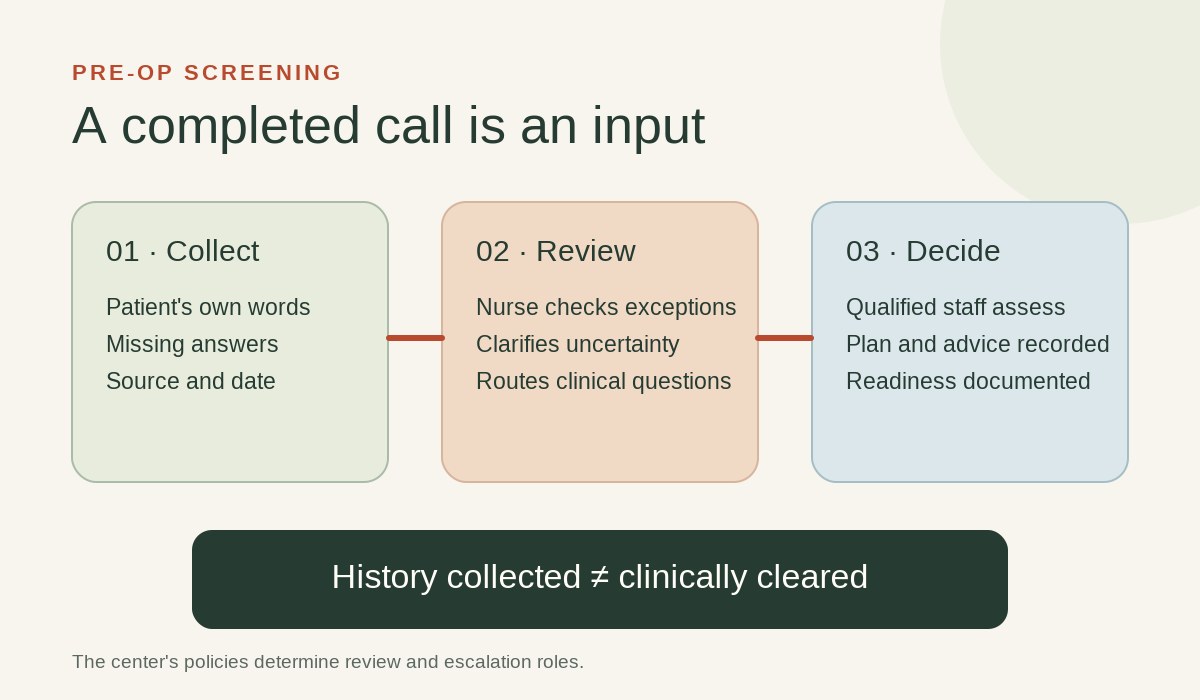
The labels describe workflow progress; they do not define the center's clinical or regulatory standard.
What pre-op screening can establish
A screening workflow can capture patient-reported history, medication names, previous anesthesia experience, allergies as reported by the patient, preparation questions, transport plans, and missing records. It can preserve the patient's own words when an answer is uncertain. It can also show who needs a callback and what changed since the last contact.
The output should say what was learned and what remains open. “Patient reports taking an anticoagulant; dose and prescribing clinician not confirmed” is operationally useful. “Medication reviewed, cleared” would imply a clinical judgment the call did not make.
This is why a history that looks complete may still need follow-up. A yes/no form can hide “not asked,” “patient unsure,” and “awaiting outside record” behind the same blank cell.
What belongs to qualified clinical staff
CMS's ASC survey guidance requires a pre-surgical assessment for each patient on admission. It also requires a physician to evaluate the procedure risk immediately before surgery and describes anesthesia risk evaluation under its separate anesthesia standard. CMS State Operations Manual, Appendix L, §416.52 and §416.42. The American Society of Anesthesiologists' Basic Standards for Preanesthesia Care assign the anesthesiologist responsibility for determining medical status and developing the anesthesia plan.
Those standards are a boundary for workflow design. They do not mean every pre-op call must be made by an anesthesiologist. They mean that collecting a response, noticing an exception, evaluating a patient's risk, and deciding whether to proceed are different tasks.
The center's licensed team and policies determine who reviews information, when the physician or anesthesia team is involved, and how urgent concerns are handled. A software tool should support that routing without labeling a patient clinically ready.
Use statuses that describe the work actually done
Avoid one ambiguous “complete” status. A practical sequence is:
| Status | What it means | Next owner |
|---|---|---|
| Contact needed | No usable history yet | Outreach team |
| History collected | Patient responses recorded | PAT or nursing review |
| Clarification needed | Answer is uncertain or missing | Assigned caller or nurse |
| Clinical review pending | Information needs interpretation | Qualified clinical staff |
| Staff decision documented | Required assessment and plan recorded | Team following center policy |
These are example workflow labels, not regulatory definitions. Your center may use different names. The key is that the screen or dashboard must not promote “history collected” to “clinically cleared” just because all fields have values.
Escalation must carry the underlying answer
A nurse who receives “positive cardiac history” without the patient's words may have to start the call again. Show the source answer, the question asked, date and channel, any conflicting record, and what was not resolved. If a patient asks a question outside the approved script, preserve that question instead of giving it a generic response.
For a patient taking a medication that may affect preparation, the collection step can record the medication and ask the patient to follow the center's approved instructions. The clinical team decides whether any individual plan needs to change. This article does not supply medication or anesthesia rules; those depend on the patient and the center's clinicians.
Make the chart tell the truth in one glance
Imagine a patient says, “I take a blood thinner, but I cannot remember the name.” A useful screening record would show the patient's words, the question asked, when the answer was captured, and “medication name unconfirmed.” It would assign the callback or clinical review according to center policy. It would not turn a completed questionnaire into a medication decision.
This example exposes a simple test for any pre-op dashboard: can the next reviewer distinguish a reported fact from a reviewed fact and a decision without reopening the entire conversation? If not, add a source field or a clearer status before adding another “complete” badge.
Measure the boundary, not only call volume
Count screenings completed, but also count how many reached nurse review, how many required correction, how many open items were assigned, and how many were closed before the center's cutoff. Sample the summaries: can a reviewer find the original response without replaying an entire call? Can the team tell what remains undecided?
For a quick audit, take 20 recent cases marked “complete” and ask a nurse reviewer whether that status meant collection, review, or a documented clinical decision. If the answer varies from case to case, the status label is doing too much work. Fix the labels before using completion rate as a performance measure.
Incerto's pre-op screening workflow shows routine collection, a fictional nurse review queue, and escalation boundaries. If your team is evaluating a process, bring one current questionnaire and decide which answers the tool may gather, which require staff follow-up, and who records the clinical decision. The pre-op nurse workload guide offers a way to measure whether that division of work helps the team.