

Why Aetna Might Reject Your Claim
Aetna's denial rate for orthopedic procedures sits between 8 and 12 percent, which is lower than most major commercial payers. That sounds reassuring until you realize the denials they do issue are almost entirely medical necessity-driven.
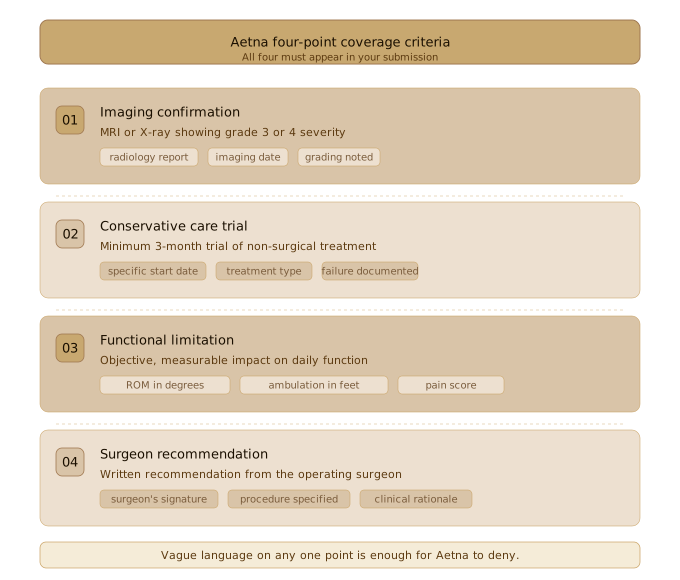
Aetna might reject your claim because your documentation did not satisfy their four-point coverage criteria: imaging confirmation at grade 3 or 4, a minimum three-month conservative care trial, documented functional limitation, and a written surgeon recommendation. In practice, if any one of those four is missing or vague in your submission, Aetna will deny the case. Not because the procedure was not warranted, but because the paperwork did not prove it was.
What a Strong Aetna Appeal Actually Needs
A strong Aetna appeal is not a long document but a precise one. You need to quote Aetna's own medical policy back to them and map your patient to it point by point: imaging grade confirmed, conservative care timeline with specific dates, functional limitation with objective numbers like range of motion in degrees or ambulation distance, and the surgeon's written recommendation.
Vague language loses. If your pre-op note says "patient reports pain," Aetna will question it. If it says "pain 8 out of 10, ROM 15 degrees flexion, ambulation limited to 150 feet," they accept it.
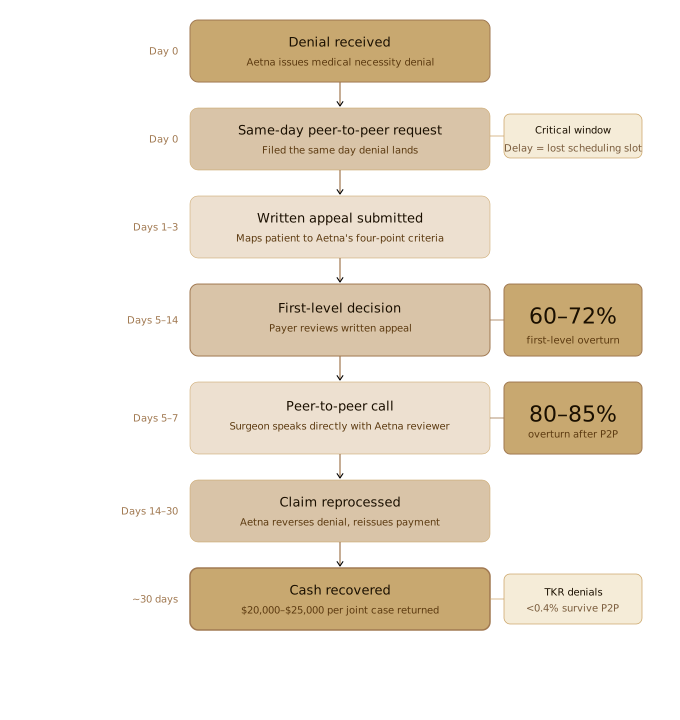
ASC billing teams need to request peer-to-peer review the same day you receive the denial. Aetna schedules peer-to-peer within five to seven business days, and once your surgeon is on that call, the overturn rate jumps to 80 to 85 percent. For total knee replacements specifically, fewer than 0.4 percent of denials survive a peer-to-peer review. The clinical record is almost always on your side. The question is whether you executed fast enough to use it.
The Revenue You Are Leaving on the Table
The number worth paying attention to: a typical orthopedic ASC appeals 25 to 30 Aetna cases per year but is eligible for significantly more. At an average joint case value of $20,000 to $25,000, and with Aetna's first-level overturn rate sitting at 60 to 72 percent, that gap adds up fast.
| ASC Appeal Volume | Eligible Cases | Cases Actually Appealed | Revenue Left on Table |
|---|---|---|---|
| Conservative | 60 cases/year | 25 cases | $154,000+ |
| Typical | 72 cases/year | 28 cases | $198,000+ |
| High Volume | 85 cases/year | 30 cases | $260,000+ |
The compounding issue is operational. Your team is working hard inside a broken process. Denials land in a first-in-first-out queue with no prioritization by dollar value and no same-day peer-to-peer protocol. The administrative cost to fight a single denied claim runs at $57 per case, which means borderline cases get written off before anyone takes a second look. Billing staff turnover runs at 33 percent annually, and institutional knowledge walks out with each departure.
ASCs that systematically appeal Aetna denials recover between $150,000 and $300,000 annually without adding a single billing staff member. This revenue gap rebuilds itself every single year.
How Incerto Handles Aetna Denials For You
The moment a denial lands, Incerto auto-tags it by payer, procedure, and dollar value, submits a same-day peer-to-peer request to Aetna, and pre-fills the appeal narrative using Aetna's four-point coverage criteria pulled directly from your chart data. Imaging grade, conservative care timeline, functional limitation scores, surgeon recommendation. Your RCM director reviews the draft in two minutes and submits. No chasing records, no rebuilding context from scratch.
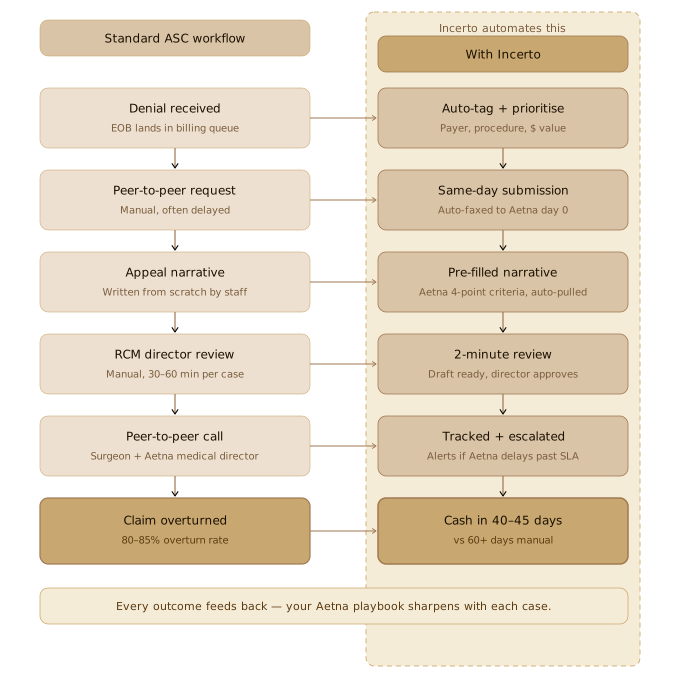
ASCs using Incerto recover a significant amount annually from Aetna appeals alone, without adding a single billing staff member. Every Aetna appeal outcome feeds back into the system, so your playbook gets sharper with each case.
If you want to see exactly what is recoverable in your last 90 days of Aetna claims, we can show you that in one conversation.
Frequently Asked Questions
- What is Aetna's denial rate for orthopedic procedures compared to other commercial payers?
Aetna's denial rate for orthopedic procedures runs between 8 and 12 percent, lower than most major commercial payers. But nearly all of those denials are medical necessity-driven, which means they are almost always winnable on appeal with the right documentation. Incerto auto-tags every Aetna denial by payer, procedure, and dollar value the moment it lands so nothing gets written off by default.
- What are Aetna's four-point coverage criteria for orthopedic procedures?
Aetna requires four things: imaging confirmation at grade 3 or 4, a minimum three-month conservative care trial, documented functional limitation, and a written surgeon recommendation. If any one is missing or vague, Aetna denies on medical necessity regardless of clinical merit. Incerto maps all four criteria directly from your chart data into the appeal before your RCM director touches the file.
- How do you write an Aetna appeal that actually gets overturned?
Quote Aetna's own medical policy back to them and map the patient to it with objective numbers. Imaging grade, conservative care dates, ROM in degrees, ambulation distance, surgeon recommendation. Vague language loses. Specific, measurable documentation wins. Incerto pre-fills this structure from your chart data so the appeal is ready to review in under two minutes.
- What is a peer-to-peer review with Aetna and when should you request one?
A peer-to-peer is a direct call between your surgeon and Aetna's medical reviewer to contest a denial. You need to request it the same day the denial arrives. Aetna schedules within five to seven business days, and the overturn rate after a peer-to-peer jumps to 80 to 85 percent. Incerto submits the request automatically the moment a denial is tagged so the window never closes without action.
- How much revenue are orthopedic ASCs losing by not appealing Aetna denials?
Most ASCs appeal 25 to 30 Aetna cases per year but are eligible for 60 to 85. At an average joint case value of $20,000 to $25,000 and a first-level overturn rate of 60 to 72 percent, that gap is $150,000 to $300,000 annually, and it rebuilds every year. Incerto closes that gap without adding a single billing staff member.
- Why do orthopedic ASCs struggle to appeal Aetna denials consistently?
Denials land in undifferentiated queues with no dollar-value prioritization and no same-day peer-to-peer protocol. Every appeal requires rebuilding context from scratch. At 33 percent annual billing staff turnover, that institutional knowledge resets constantly. Incerto eliminates the rebuild by auto-tagging denials, pre-filling appeals from chart data, and logging every outcome so the process improves over time.
- Can an orthopedic ASC recover more from Aetna appeals without hiring additional billing staff?
Yes. The gap is a workflow problem, not a headcount problem. ASCs that systematically appeal Aetna denials recover between $150,000 and $300,000 annually without adding staff. Incerto handles the prioritization, peer-to-peer requests, and appeal drafts automatically. Your RCM director reviews and submits in two minutes.