
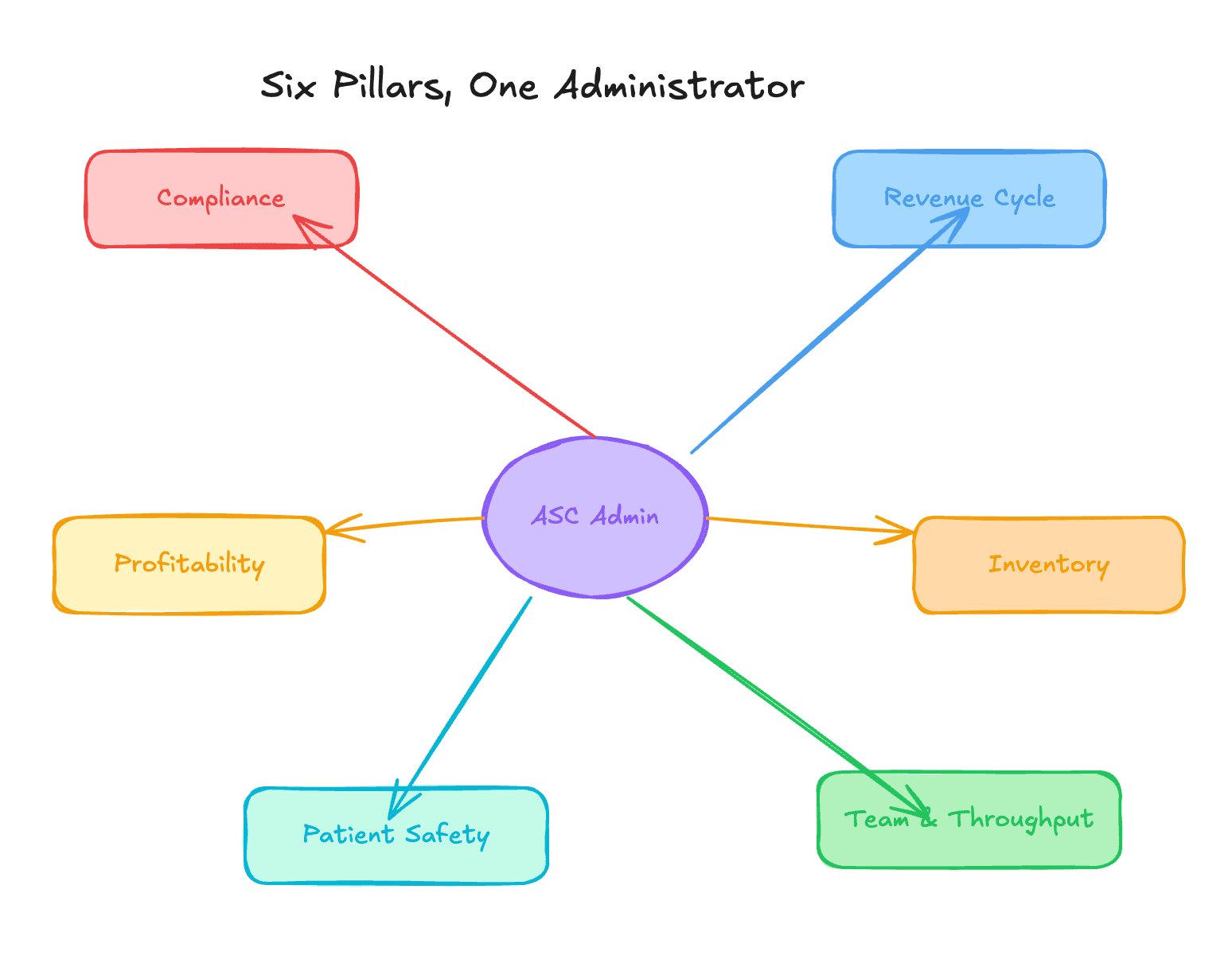
An ASC administrator's calendar on a Tuesday: a 7am huddle on first-case start times, a 9am call with a surgical supply rep renegotiating implant pricing, an 11am AAAHC mock survey walkthrough, a 1pm review of last month's denial rate by payer, a 3pm conversation with a scrub tech who's threatening to quit, and a 4:30pm look at the P&L before it goes to the ownership group.
None of these are separate jobs. They're one job, done by one person, usually without a dedicated staff for any of them.
Hospital administrators have departments. A revenue cycle director doesn't also run supply chain. A compliance officer doesn't also manage nursing turnover. At an ambulatory surgery center, one administrator typically owns all of it, on a facility that runs at 25-40% EBITDA margins with far less room for error than a hospital system carries.
Six things define the role. None of them can be neglected without the others eventually breaking.
Compliance: staying survey-ready every day, not just before the visit
AAAHC and CMS certification isn't a once-a-year event you prep for. Surveyors can show up unannounced, and the administrator is the one who has to know, at any given moment, whether the facility would pass.
That means live oversight of Quality Assurance and Performance Improvement (QAPI) programs: infection rates, incident logs, credentialing files, equipment maintenance records, and policy manuals that actually match what happens on the floor rather than what was written five years ago.
The stakes are asymmetric. A clean survey barely gets noticed. A failed one can mean a corrective action plan, a loss of accreditation, or in the worst case, a facility that can't bill Medicare at all. Administrators build "survey-ready" into daily routine, not into an annual scramble, because the alternative is existential.
Revenue cycle management: the administrator is the last line before write-offs
Most ASC administrators didn't train as billers, but they end up owning the outcomes of billing anyway. Coding accuracy, upfront prior authorization, and payer contract terms all run through decisions the administrator either makes directly or is accountable for when they go wrong.
The upfront work matters more here than in a hospital setting. A missed prior auth on a joint replacement case isn't a paperwork problem, it's a five-figure claim at risk of denial before the patient even reaches pre-op. Administrators who treat RCM as "the billing team's problem" tend to discover the gap only when cash flow does, weeks or months later, in ASC denial rates for ortho procedures that run structurally higher than what hospitals see for the same codes.
Payer contract terms are the other half. Administrators negotiate or renegotiate case rates, implant carve-outs, and bundled payment terms directly, often without a managed care department to lean on. Getting this wrong doesn't show up as a denial. It shows up as a claim that pays, at the wrong rate, and nobody notices for a year.
Inventory management: the second-largest line item after payroll
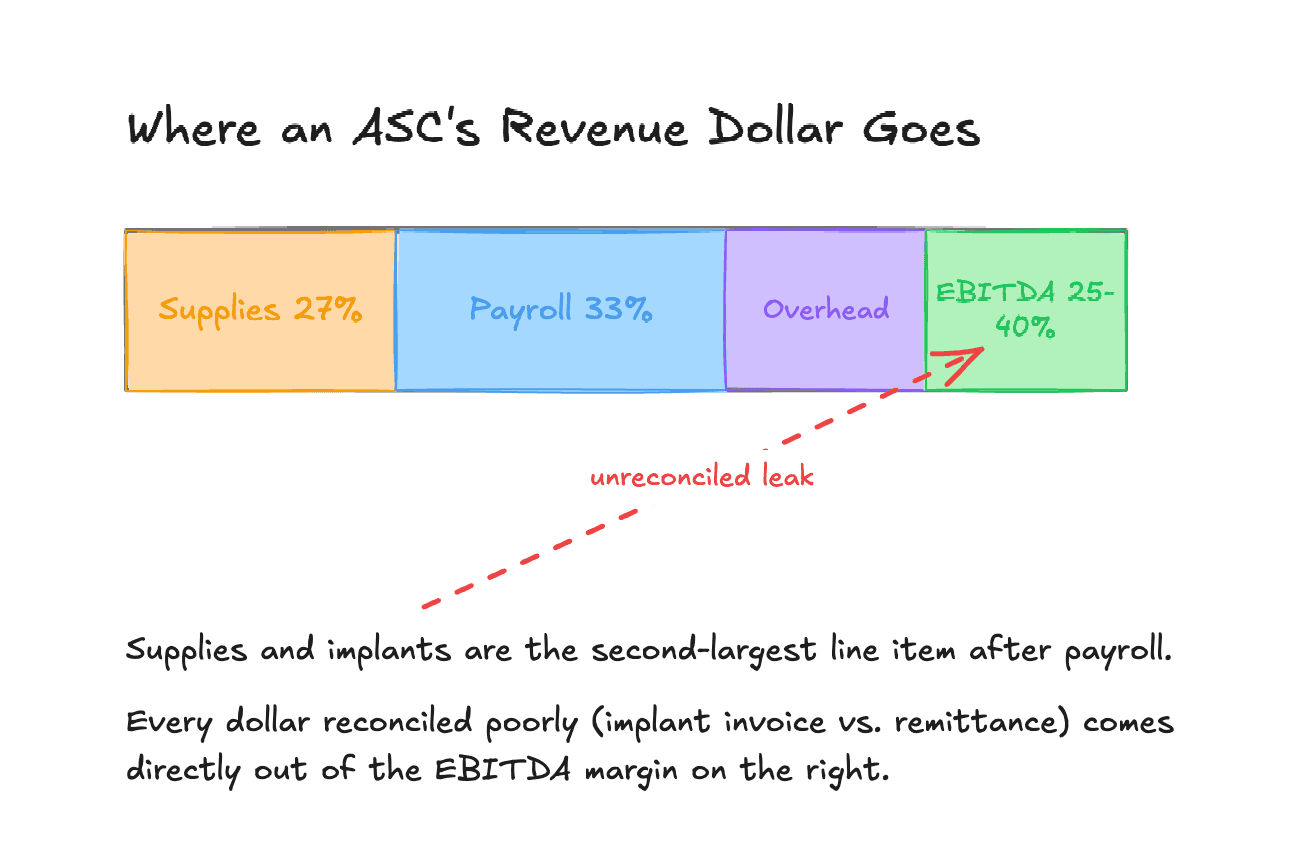
Supply costs run 25-28% of net revenue at a typical ASC, and implants alone can account for the majority of that in an ortho-heavy case mix. This is not a back-office function. It's a margin lever the administrator controls directly.
Standardization is the primary tool: reducing the number of vendors and SKUs a facility carries for a given procedure type, which increases purchasing leverage and reduces the chance a case gets delayed because the right size implant isn't in stock. Case costing, tracking the actual supply cost per procedure against what the case reimburses, tells the administrator which procedures are quietly unprofitable before the quarter-end numbers do.
Where this connects back to revenue cycle: implant costs that don't get reconciled against remittance data are a silent leak, the same implant billing revenue leakage pattern that shows up disproportionately in ortho ASCs. A facility can be paying full price for a bilateral implant case and getting reimbursed as if it were unilateral, and unless someone is checking invoice against payment line by line, it never surfaces as a denial. It just erodes margin.
Team culture and throughput: the pit crew standard
ASCs compete on turnover time. A facility that can't get from case-end to next-patient-in-room in under 15 minutes loses the throughput advantage that makes the ASC setting viable in the first place. That number isn't hit by a scheduling system. It's hit by a team that operates like a pit crew: cross-trained, aligned on the sequence, and not siloed by department.
The administrator's job here is cultural, not just operational. Nursing, sterile processing, and front desk each optimize for their own function unless someone actively builds shared incentives across them. Toxic siloing, where sterile processing blames scheduling and scheduling blames the surgeons, is the single fastest way to lose the turnover time that makes an ASC's economics work at all.
Staff retention compounds this. An RCM team with high turnover loses payer-specific knowledge the same way a clinical team loses procedural rhythm, both cost real time and real money to rebuild, a version of what RCM staff turnover actually costs that plays out just as sharply on the clinical side of the building.
Patient safety and care: the non-negotiable constraint
Every other pillar operates inside this one. Pre-op protocols, intra-op safety checks, and post-op discharge criteria aren't optional even when throughput pressure is high. Infection control specifically carries outsized weight for ASCs, both because outbreaks can trigger accreditation review and because same-day discharge means the facility has less margin for post-op complications than an inpatient setting would.
Administrators who chase turnover speed at the expense of safety protocol eventually pay for it twice: once in patient outcomes, and once in the compliance review that follows.
Profitability: where the other five pillars either add up or don't
25-40% EBITDA margins sound healthy in isolation. What makes them fragile is that they depend on getting compliance, RCM, inventory, staffing, and safety right simultaneously, with reimbursement rates under continuous pressure from payers and CMS.
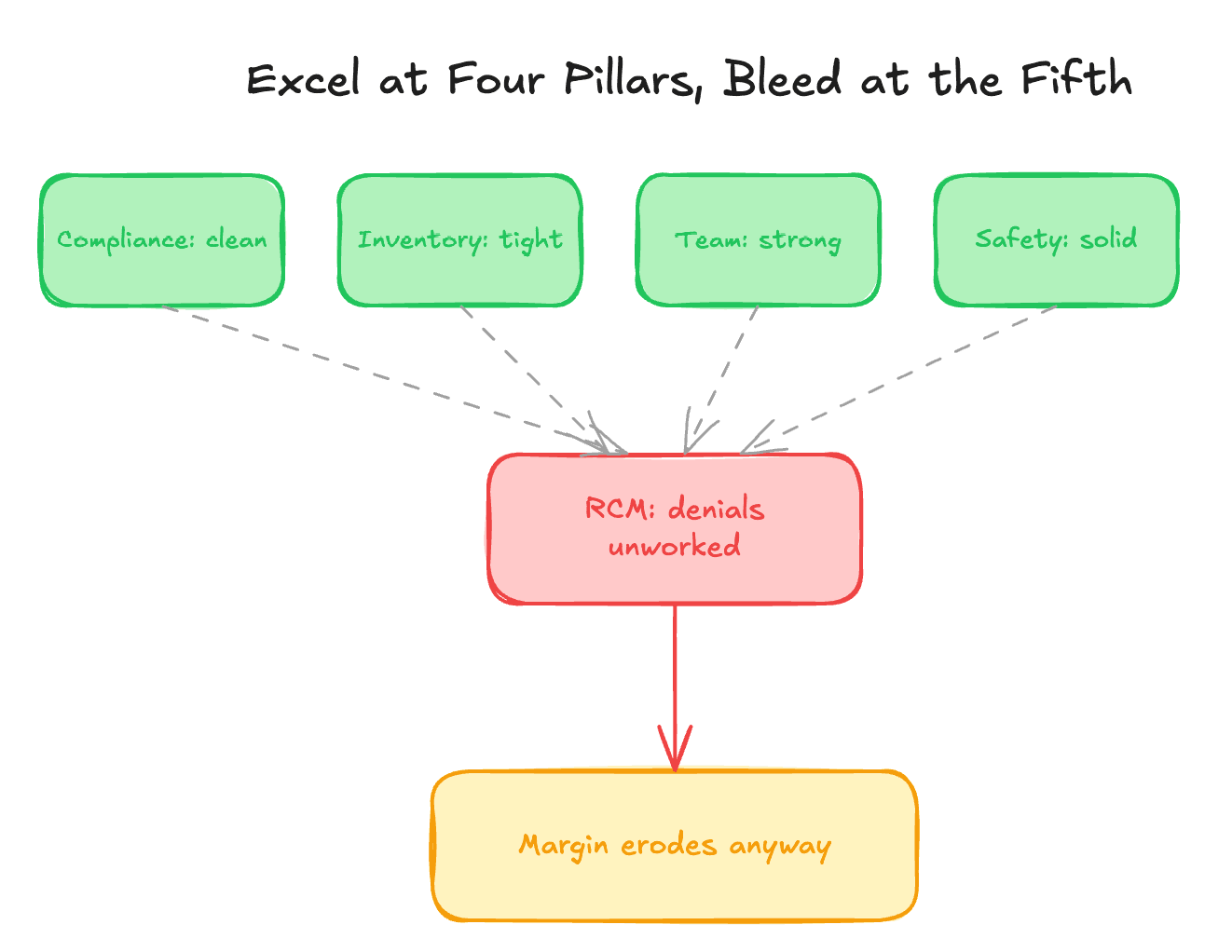
A facility can excel at four of the five pillars and still bleed margin through the fifth. Tight inventory management doesn't save a facility that's leaving revenue in a denial queue nobody works. Clean compliance doesn't offset a supply chain that's overpaying on implants. The administrator is the only role positioned to see all five inputs at once and act on the ones that are actually dragging the P&L down, which is why the job resists being split across specialized staff the way it eventually gets split in a hospital system.
The orchestration problem
None of these six pillars is optional, and none of them functions well in isolation. An ASC administrator isn't managing six departments. They're synthesizing data, culture, and compliance into one operating model, on a facility with far less staff depth than the complexity of the job would suggest.
That's the part that doesn't show up in a job description: the administrator is usually the only person in the building who can see when a supply chain decision is actually a revenue cycle problem, or when a staffing gap is about to become a safety issue. The role works because one person holds the whole picture. It also breaks in exactly the way you'd expect when that person doesn't have the bandwidth or the systems to hold it.
If any of this sounds like your Tuesday, the gap usually isn't effort. It's that revenue cycle work in particular, prior auth follow-up, denial tracking, implant reconciliation, requires the kind of continuous, detail-level attention that's the first thing to slip when compliance or staffing needs the administrator's time instead.