
When a billing manager leaves an ASC, there's a standard playbook. Post the job, bring in a temp, hope the next hire ramps faster than the last one.
What rarely gets counted is what actually left.
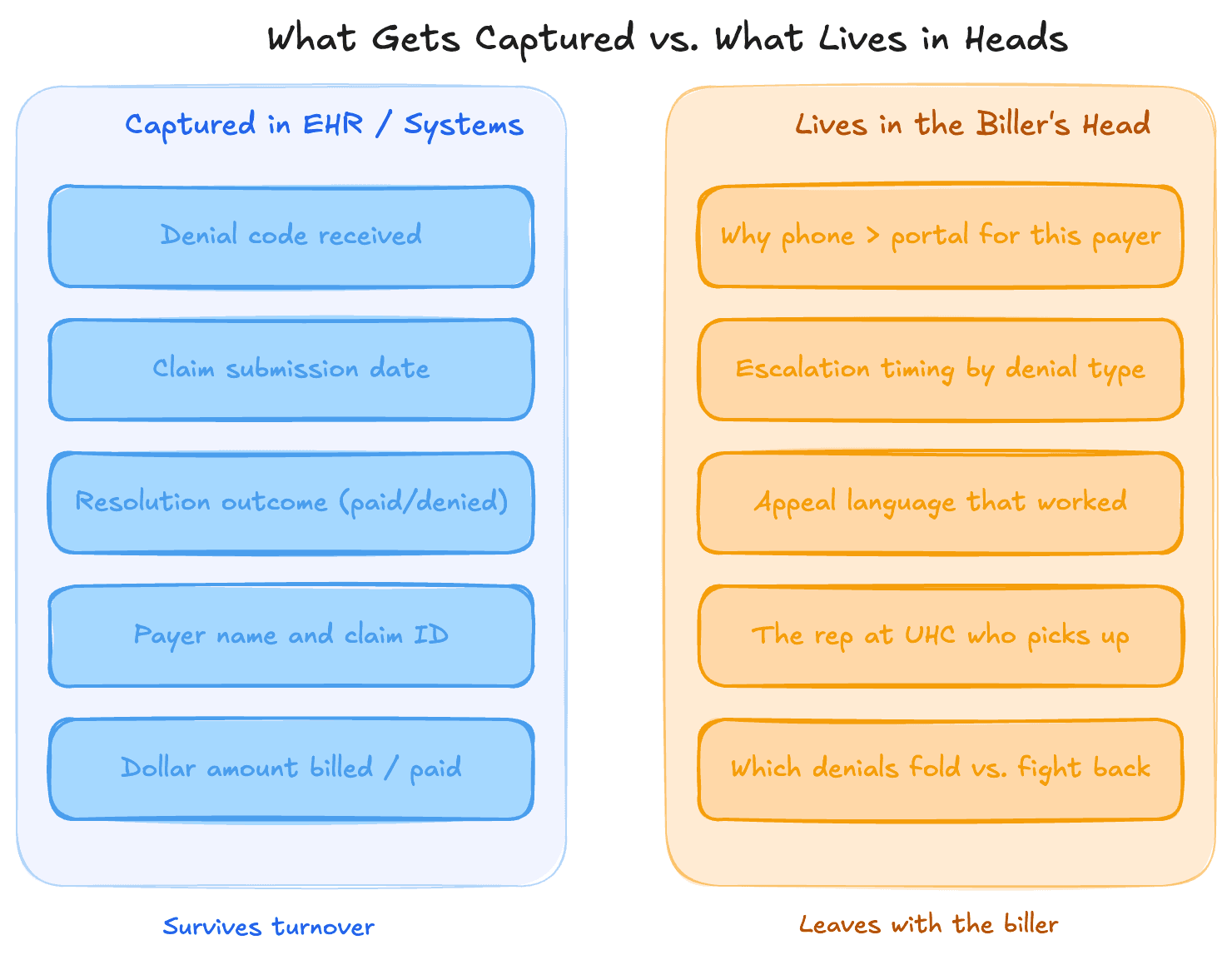
It wasn't just a seat in the billing office. It was three years of working the same payers, on the same procedure codes, for the same surgeons. It was knowing that BCBS Texas requires a phone call after day 45 on implant denials, not a web portal submission. It was the direct number of the claims rep at UHC who actually resolves ortho disputes. It was the institutional feel for which denials fight back and which ones fold on the first appeal.
That's not in the job description. It's not in the EHR. It leaves with the person.
This is the RCM staff turnover cost problem. And it's bigger than most healthcare finance teams measure.
What the Numbers Actually Look Like
Annual turnover in healthcare revenue cycle management runs between 25% and 30% per year. For a 10-person billing team, that's 2 to 3 people leaving every 12 months.
The direct recruiting cost gets attention. Job board fees, recruiter commissions, onboarding time. For a mid-level biller, that's 8,000 in direct costs before they've touched a claim.
But the harder number is the ramp. A new biller does not reach full productivity in 90 days. According to MGMA benchmarking data, the actual curve for specialized billing roles runs 12 to 18 months before a new hire has built the payer-specific muscle memory that experienced billers carry automatically.
During that ramp window, clean claim rates dip. Appeals get filed generically. AR aging climbs as lower-priority claims slip through.
For an ortho ASC doing 500,000 per month in collections, that ramp period is not a minor inconvenience. It's a recoverable loss that most operators never measure because it blends into "normal variance" on the monthly AR report.
Herd Knowledge: What Leaves When a Biller Leaves
RCM work generates institutional knowledge constantly. Every claim that gets denied and successfully appealed is a data point. Every payer that required a modifier override, a pre-cert re-submission, or a peer-to-peer review adds a layer to how a biller understands their book of work.
Almost none of this gets written down.
What does get documented: the denial code, the date, the resolution. What doesn't: why a biller chose to appeal by phone instead of portal for that specific payer. Why they waited until day 50, not day 30, to escalate. Who they called and what language they used in the appeal letter that actually worked.
This is herd knowledge: the accumulated, undocumented reasoning behind every working claim decision. It's payer-specific. It's learned over time. And when a biller leaves, it goes with them.
The replacement biller isn't starting from zero. They have the denial history in the system. What they don't have is the context that made that history actionable. We cover the structural dimension of this in more depth in the 18-month biller turnover problem, which looks at how knowledge loss compounds when departures happen in sequence.
Where the Revenue Loss Shows Up
The financial impact doesn't appear as a single line item. It distributes across the revenue cycle in ways that are easy to attribute to other causes.
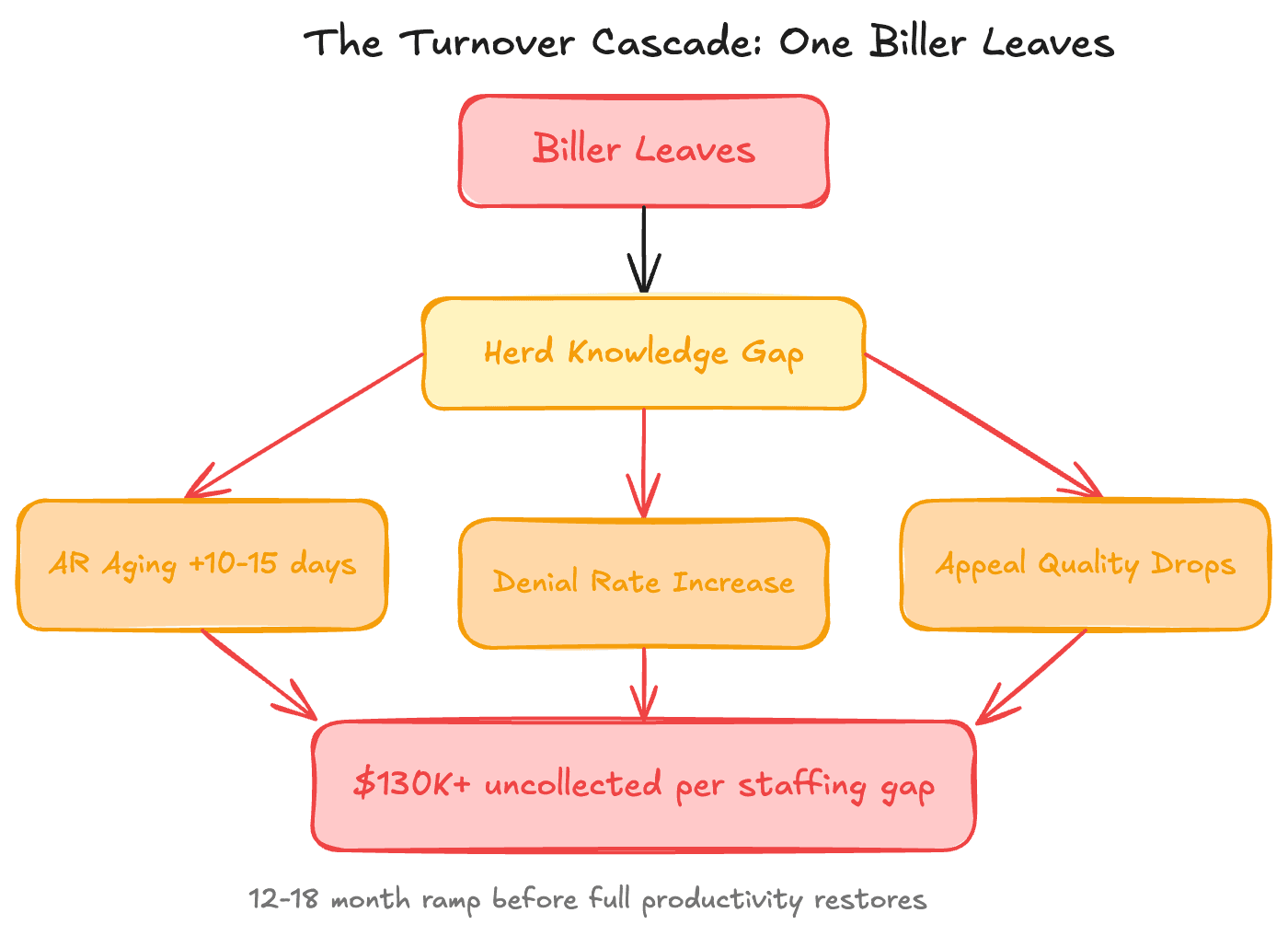
AR aging. When a biller leaves and a replacement is still learning, the oldest claims in the queue often go untouched. Appeals approaching timely filing limits get missed. The 90-day denial recovery clock runs out. By the time the new biller is up to speed, the AR aging report has moved in a direction that looks like a collections problem, not a staffing problem. Our analysis of AR aging and revenue recovery covers how this pattern presents across billing teams of different sizes.
Denial rate variance. A new biller working unfamiliar payers generates more technical denials. Not because they're incompetent, but because they don't yet know that Aetna requires modifier 59 appended differently for a specific CPT range, or that a particular payer demands clinical documentation attached at first submission rather than during appeal. These are learned behaviors that take months to acquire.
Appeal quality drop. Generic appeal letters, regardless of how accurate the underlying clinical argument is, perform worse than payer-specific appeal language built from experience. A biller who has worked United Healthcare denials for two years knows how United phrases its own coverage criteria. A new hire doesn't. The appeal hit rate drops until they learn.
Lost relationships. Payer claims reps are individuals. When a claim is stuck and needs a human conversation, knowing who to call shortens resolution time by days or weeks. Those contact relationships don't transfer. They rebuild from scratch with every new hire.
MGMA data puts the AR aging increase from a mid-cycle billing staffing gap at 8 to 15 additional days. For an ASC collecting 130,000 sitting uncollected at any given time.
Why This Is an AI Problem, Not Just an HR Problem
The standard response to RCM turnover is an HR response: improve comp, reduce workload, build a better culture. Those levers are real and should be pulled.
But the core problem isn't that people leave. The core problem is that when they do, knowledge leaves with them because the knowledge was never in a system.
RCM workflows are built around the person. A biller learns a pattern and carries it in their head. The EHR captures the claim outcome, not the reasoning. The work gets done, but the decision-making process that produced it disappears.
This is the same architectural fragility that explains why linear RCM workflows break at scale. When the human is the processing unit, the system's knowledge ceiling is defined by who showed up today.
An AI agent approaches the problem differently. Not by replacing the biller's judgment, but by building a system where judgment gets recorded and persists.
Every claim an agent works produces a structured decision log: which action was taken, which payer rule was applied, what documentation was attached, what the outcome was. That log doesn't retire. It doesn't accept a competing offer.
Over time, that outcome data becomes a working version of herd knowledge: payer-specific claim routing, appeal language calibrated to denial code and payer, escalation triggers based on what has actually produced results for similar claims.
The knowledge accumulates. It doesn't walk out.
What a Knowledge-Persistent System Changes
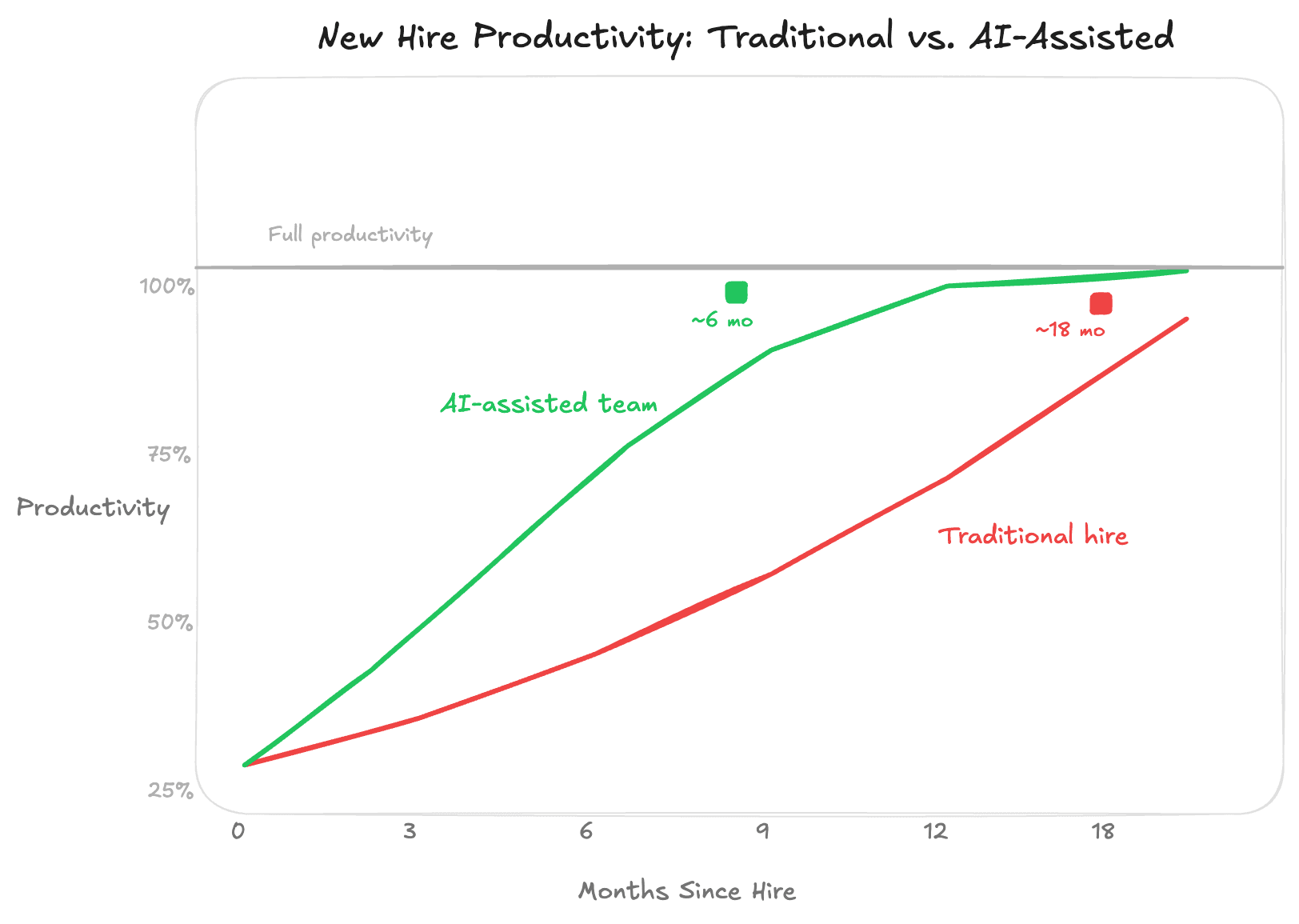
When a biller leaves an AI-assisted team, the replacement doesn't inherit a blank slate. They inherit a system that has documented patterns: which denials for which payers have historically responded to which appeal types. Which procedure codes at this facility generate the most prior auth friction. Which claims in the current AR queue have the most recovery potential.
The new biller still needs to learn the job. But the ramp period compresses because the institutional knowledge lives in the system, not in the person.
For a small billing team handling 400 to 600 cases per month, that compression matters. The difference between a 12-month ramp and a 4-month ramp is real money.
It also changes the retention equation at the margin. One of the sources of RCM staff burnout is the invisible weight of being the sole carrier of institutional knowledge: knowing that if you leave, something critical breaks. A system that captures what they know reduces that weight. Not permanently, but enough to matter.
The Cost You're Not Measuring
RCM departments track turnover rate, time-to-fill, and direct recruiting cost. These are real numbers and they're easy to pull.
What's harder to track is the revenue performance delta during the post-departure ramp: the additional denials generated, the appeals not filed before timely filing cutoff, the AR aging that accumulated while the new hire was still learning which payer needs what.
For most facilities, that cost is buried in variance. It's not attributed to turnover because nobody measured the baseline before the departure. It's not visible in the recruiting cost because it doesn't show up there. It exists in the gap between what the billing team produces and what they would produce if nothing had changed.
That gap is where RCM staff turnover actually costs money. The recruiter invoice is the easy part.
If your denial rate has climbed or your AR aging has drifted in the last 90 days, and you've had any staffing changes in your billing department, you're probably looking at that gap now.