

The business office sent estimates for last week’s cases. At close, the report shows $5,900 collected, but it is unclear how much came in before surgery day, how much came in at check-in, and whether the amount originally expected changed.
To measure upfront collections at an ambulatory surgery center (ASC), follow the same group of cases from the approved expected deposit through payment. Report dollars collected before surgery day and cumulative dollars by the end of check-in. Track changes to the expected amount and explain what is still open.
Choose one group of cases and two cutoffs
Start with a defined surgery-date cohort, such as all visits that reached check-in during a given week and had a positive expected deposit. Log pre-check-in cancellations separately. Record the approved expected deposit on each case, the version and time it was approved, and any later changes with their reason. Show missing expectations and approved zero-deposit cases as separate counts so readers can see which cases the ratio covers.
Use two cutoffs for the same included cases:
- Before surgery day. Apply receipts posted or timestamped before the surgery date, using your own consistent definition for receipt timing.
- Through check-in. Add payments received on surgery day through the end of each patient’s check-in. Report this as cumulative and show the added amount separately.
Count payments applied to the expected deposit. Keep refunds and reversals visible, and document how corrections and consolidated transactions get allocated to individual cases. The denominator should reflect the center-approved expectation at your stated cutoff. Show the original total alongside it when revisions matter.
Reconcile expected deposits with actual payments
| Fictional example | Amount | How to read it |
|---|---|---|
| Originally expected | $8,500 | Approved amounts when estimates were issued |
| Approved adjustments | −$500 | Documented revisions before check-in |
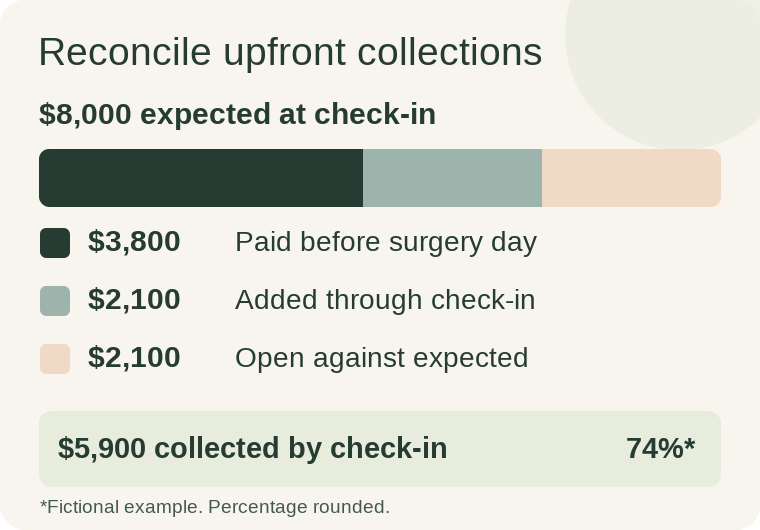
| Expected at check-in | $8,000 | Denominator for both timing measures |
| Collected before surgery day | $3,800 | 47.5% of the expected amount |
| Additional payments through check-in | $2,100 | Excludes the $3,800 already counted |
| Total collected through check-in | $5,900 | 73.75% of the expected amount |
| Open against expected deposits | $2,100 | Amount still open at the cutoff |
Keep the open amount visible alongside case counts for partial payments and approved arrangements. Some amounts may be subject to later changes or collections. Use the estimate scope guide to keep charges handled by another provider out of the ASC’s facility reconciliation.
Use benchmarks with their definitions attached
HST Pathways defines its patient deposit collection rate as actual deposits divided by expected deposits. For 2025, the centers it analyzed reported $254.7 million collected against $380.1 million expected, about 67%. The report draws on HST clients. Compare only when the cohort, expected amounts, and timing definitions line up with yours. HST industry report and metric definitions
Start by reconciling one week against the office’s estimate records, payment ledger, and check-in times. Ask which open items came from a revision, unclear estimate scope, a patient question, or an approved arrangement. Our ASC verification guide shows what to preserve upstream so the business office can trace the expectation later.