

How Medical Billing Works
The AMA reports approximately 1 in 5 claims is denied on first submission. Each denial is revenue that exists on paper but has not moved. Working those denials back to payment is the job of appeals but appeals take time, documentation, and prioritization that most billing teams do not have in surplus.
The result is a backlog with a clock on it. Most payers enforce timely filing limits of 90 to 180 days from date of service. Once that window closes, the claim is not delayed. It is written off.
Signs Your Backlog Is Out of Control
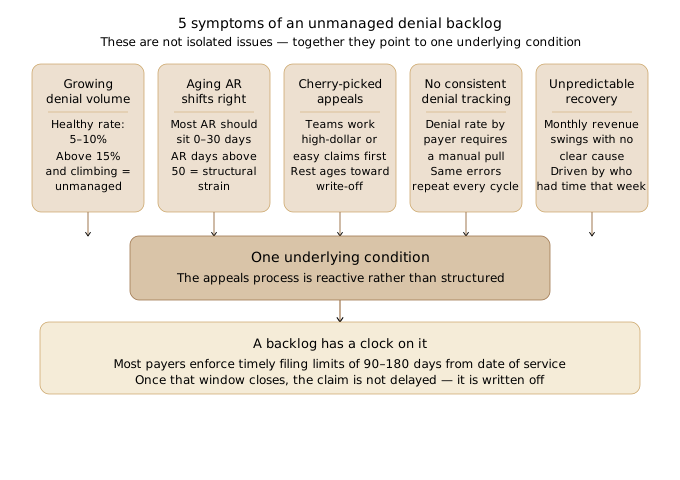
The visible signs are not isolated issues, they are a pattern with a name: an unmanaged backlog.
Growing denial volume with no ceiling. A healthy denial rate is 5-10% of submitted claims. Above 15% and climbing means the backlog is accumulating faster than it is being resolved.
Aging AR shifting right. When denied claims age into the 60, 90, and 120-plus day columns without resolution, the appeals process has no consistent throughput.
Cherry-picked appeals. Teams gravitate toward high-dollar or easy-to-fix claims. Mid-range and complex denials age silently toward write-off.
No denial tracking. If "what is our denial rate by payer" requires a manual report, there is no feedback loop. The same errors repeat indefinitely.
Together these indicate one underlying condition: the appeals process is reactive rather than structured.
The Four Structural Gaps
These symptoms trace back to four gaps in how the appeals process is built, not effort or staffing.
No prioritization framework. Claims are worked in the order they arrive. Low-complexity claims consume the same bandwidth as high-value claims 60 days from expiry.
No backlog segmentation. Without segmenting by age, payer, and value, there is no visibility into which portion is most at risk.
Manual workflows, no throughput tracking. Bottlenecks are invisible until claims expire.
No learning from past denials. A payer denying the same CPT code 40 times generates 40 separate appeals instead of one corrective action.
What Your Backlog Is Worth
For a mid-size practice submitting 500 claims/month at $1,200 average value, a 5-10% denial rate means $30,000-$60,000 entering the backlog every billing cycle. A backlog unworked for 90 days does not stay the same size. It ages, and portions become unrecoverable.
| Age Bucket | Claims | Total at Risk | Recovery Likelihood |
|---|---|---|---|
| 0-30 days | 50 | $60,000 | High |
| 31-60 days | 40 | $48,000 | Moderate |
| 61-90 days | 30 | $36,000 | Low to moderate |
| 90+ days | 20 | $24,000 | Low, approaching write-off |
| Total | 140 | $168,000 |
On a $168,000 backlog, the gap between 40% and 75% recovery is $58,800 in additional revenue from the same claims.
The 90-Day Recovery Benchmark
| Milestone | Backlog Touched | Recovery Rate | Avg. Resolution Time | Status |
|---|---|---|---|---|
| 30 days | 40-50% | 30-40% | 45-60 days | Actively segmented |
| 60 days | 70-80% | 50-60% | 35-45 days | Patterns emerging |
| 90 days | 90-95% | 65-80% | 25-35 days | Normalized, reportable |
30 Days: Initial Traction
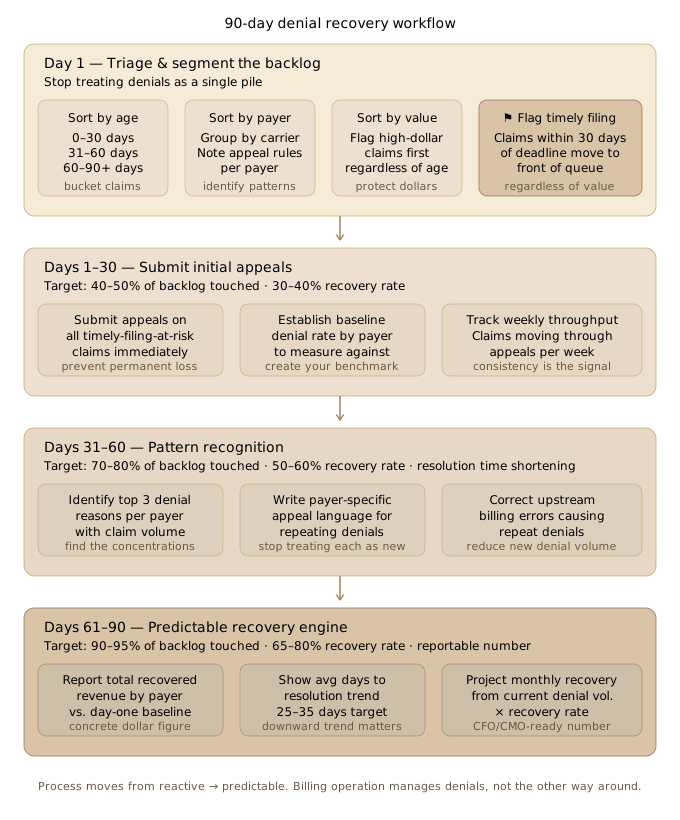
The first 30 days are about foundation, not recovery numbers. The backlog gets segmented by age, payer, and value for the first time. Claims approaching timely filing limits move to the front of the queue regardless of dollar value. The key signal is throughput: how many claims are moving through appeals per week, and whether it is consistent.
By day 30 you should have: a segmented backlog view, active appeals on all claims within 30 days of expiry, and a baseline denial rate by payer.
60 Days: Pattern Recognition
By day 60, data depth starts showing patterns. Specific payers surface as denial drivers. 40% of denied volume may be concentrated in two payers, or one denial reason code repeating across a CPT group. These are not random. They are systematic behaviors addressable with payer-specific appeal language and upstream corrections.
Recovery rates should reach 50-60% on worked claims, with resolution time shortening as the team stops treating every denial as a new problem.
By day 60 you should have: top three denial reasons per payer, recovery rate by payer, and measurable reduction in new denials from corrected billing errors.
90 Days: Predictable Recovery Engine
At 90 days, the practice has something it did not have before: a number reportable with confidence. The backlog is largely resolved or in active appeal. New denials are worked within a defined cycle rather than accumulating. Recovery rates have stabilized at 65-80%.
The difference between 35% recovery at day one and 75% at day 90 is a concrete dollar figure. That is what a CMO or CFO needs to see.
By day 90 you should report: total recovered revenue by payer, current vs. day-one denial rate, average days to resolution trend, and projected monthly recovery.
The 90-day arc does not mean the work is done. It means the process has moved from reactive to predictable.
What You Recover in 90 Days
| Recovery Category | Typical Window | Systematic | Ad-hoc |
|---|---|---|---|
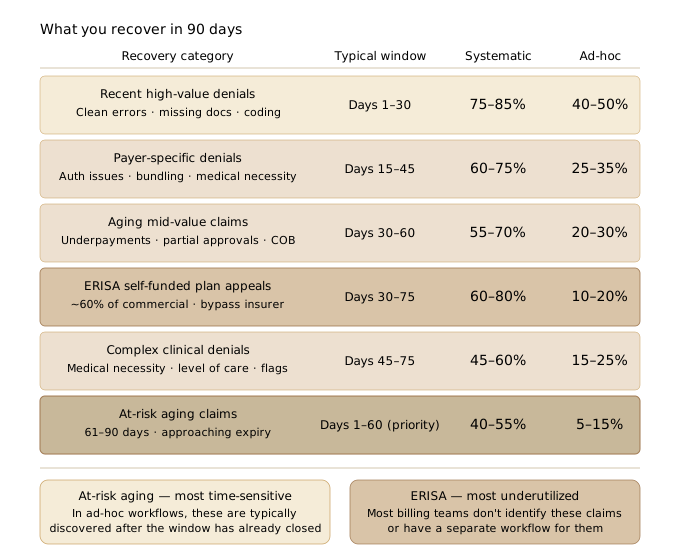
| Recent high-value denials (clean errors, missing docs, coding) | Days 1-30 | 75-85% | 40-50% |
| Payer-specific denials (auth, bundling, medical necessity) | Days 15-45 | 60-75% | 25-35% |
| Aging mid-value claims (underpayments, partial approvals, COB) | Days 30-60 | 55-70% | 20-30% |
| ERISA self-funded plan appeals | Days 30-75 | 60-80% | 10-20% |
| Complex clinical denials (medical necessity, level of care, flags) | Days 45-75 | 45-60% | 15-25% |
| At-risk aging claims (61-90 days, approaching expiry) | Days 1-60 (priority) | 40-55% | 5-15% |
At-risk aging claims are the most time-sensitive in ad-hoc workflows. They are typically discovered after the window has already closed.
ERISA claims are the most underutilized. Approximately 60% of commercially insured patients are on self-funded employer plans governed by ERISA. Appeals go to the plan administrator, not the insurer, with reimbursement terms often more favorable than standard out-of-network rates. Most billing teams neither identify these claims nor have a separate workflow for them.
Why Most Billing Teams Never Use the 90-Day Window
Most payers allow 90-180 days to appeal and collect. That is enough time to build a structured process, identify patterns, correct upstream errors, and collect on the majority of denials. Most billing teams do not use it that way.
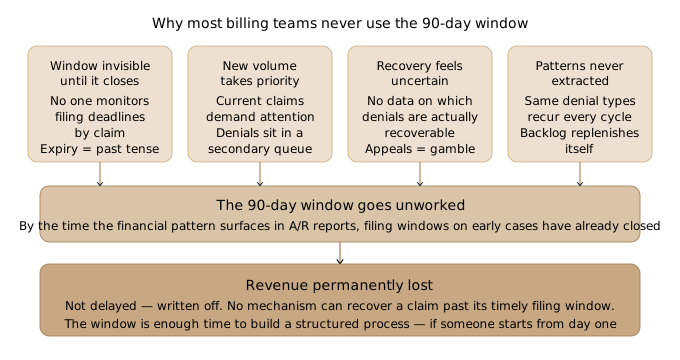
The window is invisible until it is almost closed. Expiry dates only surface when they have already passed. By then it is too late to build a complete appeal.
New volume takes priority. Denied claims sit in a secondary queue worked when time allows. Current volume consistently displaces backlog recovery.
Recovery feels like a gamble. With no data on which denials are recoverable at what rate, teams direct effort toward certainty and let ambiguous denials age.
Patterns are never extracted. The most valuable thing a denial backlog contains is information about what is going wrong upstream. Without surfacing it, the same denials recur, the backlog replenishes itself, and the window gets wasted on the same claim types every month.
How Incerto Works Your Entire Backlog
Systematic denial recovery requires infrastructure most billing teams do not have and standard RCM vendors do not build: segmented prioritization, continuous timely filing tracking, payer-specific appeal logic, and a feedback loop connecting denial patterns to upstream billing behavior.
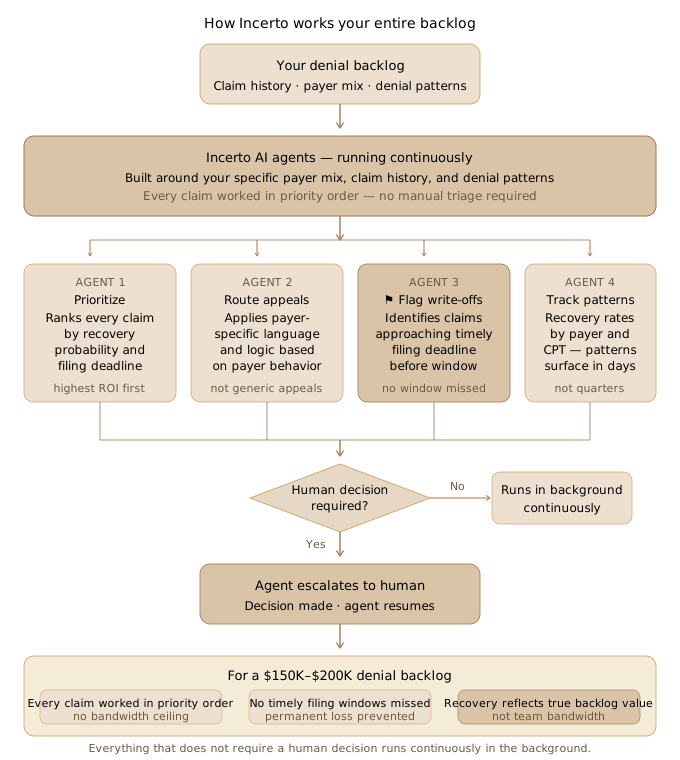
Incerto runs AI agents continuously across your backlog, prioritizing by recovery probability and filing deadlines, routing appeals by payer behavior, flagging claims approaching write-off, and surfacing patterns at the payer and CPT level in days rather than quarters. When a human decision is required, the agents escalate. Everything else runs in the background.
For a practice carrying a $150,000-$200,000 denial backlog: every claim worked in priority order, no timely filing windows missed, and recovery rates that reflect what the backlog is actually worth.
If you made it here, Incerto would be happy to give you a free RCM audit. You can travel back to home page and book a call with us.