
Ortho ASCs Are Booming. So Are Their Denial Rates.
Orthopedic procedures are migrating out of hospitals at an accelerating pace. Total joints, spinal decompressions, complex arthroscopies: procedures that lived in hospital ORs five years ago are now routine at ambulatory surgery centers.
The shift makes financial sense. Lower overhead, better margins, stronger patient throughput. But there's a catch that doesn't show up in the growth narrative.
Orthopedic ASCs consistently post higher denial rates than virtually every other outpatient specialty. Not slightly higher. Meaningfully higher. And for billing managers running these facilities, this isn't a surprise. It shows up in your AR aging, in your appeal queues, in the same payer disputes recurring month after month.
The procedures got more complex. The billing environment got harder. Most RCM infrastructure didn't keep up.
The Billing Complexity Built Into Every Ortho Case
Orthopedic ASCs don't just perform more complex procedures than other outpatient specialties. They bill for them in a fundamentally different way. Three structural factors make ortho ASC billing harder than almost anything else in the outpatient setting.
Implant billing. Most outpatient specialties bill for services. Orthopedics bills for services and high-cost hardware simultaneously. Every implant (whether a total knee system, a spinal cage, or a fixation device) needs to be billed correctly as either bundled or itemized depending on the payer contract. That distinction requires matching surgical invoices to claims in real time, with documentation that satisfies each payer's specific threshold. Miss it, and the denial follows automatically.
Prior authorization. High-cost implants trigger prior auth requirements that don't exist for most outpatient procedures. Payer rules are inconsistent, frequently updated, and rarely transparent. What was approved last quarter may require additional documentation this quarter. The administrative burden falls entirely on the billing team working the ASC.
Modifier complexity. Orthopedic cases frequently involve multiple procedures in a single operative session: bilateral cases, staged repairs, add-on codes. Each combination requires precise modifier application to signal medical necessity and avoid automatic bundling edits. A single modifier error on a complex case can trigger a denial on the entire claim, not just the disputed line.
None of this reflects poor billing practice. It reflects the reality of what orthopedic ASCs are being asked to document, justify, and defend in every case.
The Four Denial Drivers Ortho ASCs Deal With Constantly
Orthopedic ASCs face denial patterns that are specific, recurring, and structurally baked into how these cases are billed.
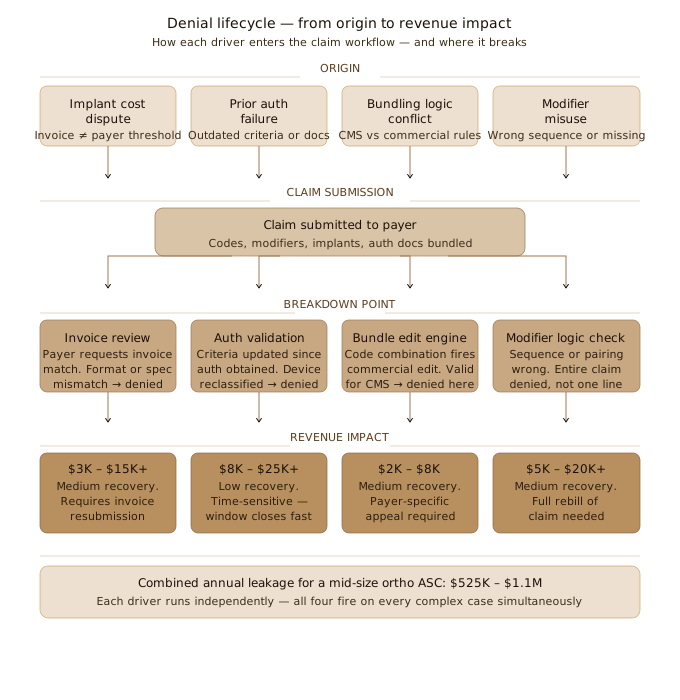
1. Implant Cost Disputes and Invoice Documentation Gaps
Payers don't take your word on implant costs. They want invoices matched to the claim with specificity.
The challenge:
- Multiple vendor relationships with inconsistent invoice formats
- Payer-specific documentation thresholds that vary by contract
- Manual, fragmented processes dependent on individual staff knowledge
When documentation doesn't meet the payer's internal threshold, the implant cost gets disputed or denied outright. This is one of the most common (and most avoidable) denial categories in ortho ASC billing.
2. Prior Auth Failures on High-Cost Hardware
Prior authorization for implants is not a one-time clearance. The failures here rarely come from not obtaining auth at all.
They come from:
- Auth obtained under outdated criteria
- Device categories that have since been reclassified
- Documentation language that doesn't match the payer's current requirements
Payers update criteria regularly, add step therapy requirements, and apply different rules by device category. What was sufficient six months ago may not be today.
3. Bundling Logic Conflicts Between CMS and Commercial Payers
CMS bundling rules and commercial payer bundling rules do not always align. Ortho cases with multiple procedure codes are especially vulnerable because:
- A claim structured correctly for Medicare may trigger a commercial payer bundling edit
- The combination of codes, not any single code, triggers the edit
- Billing teams have to maintain two sets of logic simultaneously
Gaps in that knowledge produce consistent, repeatable denials.
4. Modifier Misuse on Complex Multi-Procedure Cases
Bilateral procedures, staged repairs, and add-on codes all require precise modifier combinations. The margin for error is narrow:
- A missing modifier or wrong sequence can deny the entire claim, not just the disputed line
- The clinical work was done correctly
- The coding intent was right
- The execution just didn't match payer expectations precisely enough
How these denial drivers stack up:
| Denial Driver | Denial Frequency | Revenue Impact Per Claim | Recoverability |
|---|---|---|---|
| Implant cost disputes | High | $3,000 – $15,000+ | Medium (documentation intensive) |
| Prior auth failures | High | $8,000 – $25,000+ | Low (time-sensitive) |
| Bundling logic conflicts | Medium | $2,000 – $8,000 | Medium (payer-specific appeals) |
| Modifier misuse | High | $5,000 – $20,000+ | Medium (rebilling required) |
What the Numbers Actually Show
The data makes the stakes concrete. Orthopedic ASCs carry the highest revenue per case of any outpatient specialty. They also carry the highest denial rates. That combination is where the financial damage happens.
| Metric | Orthopedic ASCs | Industry Average |
|---|---|---|
| Denial Rate | 14 – 22% | 11.8% |
| Avg. Net Revenue Per Case | $6,400+ | $3,200 – $4,500 |
| Prior Auth Denial Rate (Medicare Advantage) | 7.4% (2025) | 3 – 4% |
| At-Risk Revenue (1,500 cases/year) | ~$1.4M annually | ~$400 – $600K |
| Single Denied TKA Claim | $11,000+ at risk | N/A |
Medicare Advantage plans denied 7.4% of prior authorization requests for orthopedic procedures in 2025, up from 5.9% in 2023. That trajectory matters.
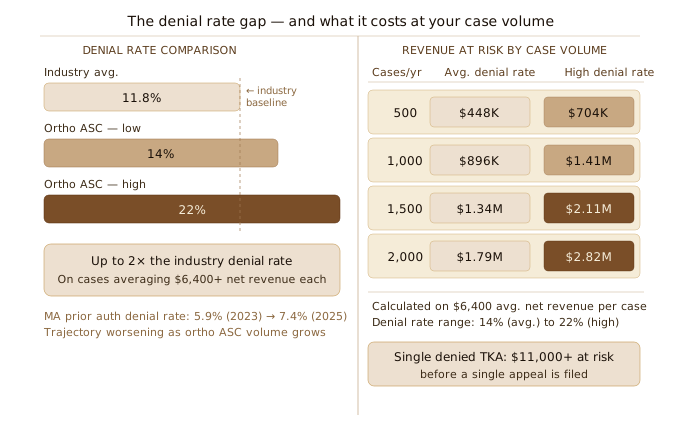
As ortho case volumes in ASCs keep climbing, the denial exposure compounds directly.
The procedures are growing. The payer scrutiny is growing faster.
Why Ortho ASCs Can't Escape This Problem
Most billing managers at ortho ASCs know exactly where their denials are coming from. The trap is structural, and it closes from both sides.
On one side, the volume economics don't support dedicated infrastructure. Hiring staff who specialize exclusively in implant billing, payer contract monitoring, and denial pattern analysis requires a case volume that most independent ortho ASCs simply don't run. The gap between average and top-quartile performers is almost always traceable to revenue cycle infrastructure, not case volume. But building that infrastructure requires the revenue that the infrastructure gap is already costing you. It is a difficult cycle to break without outside intervention.
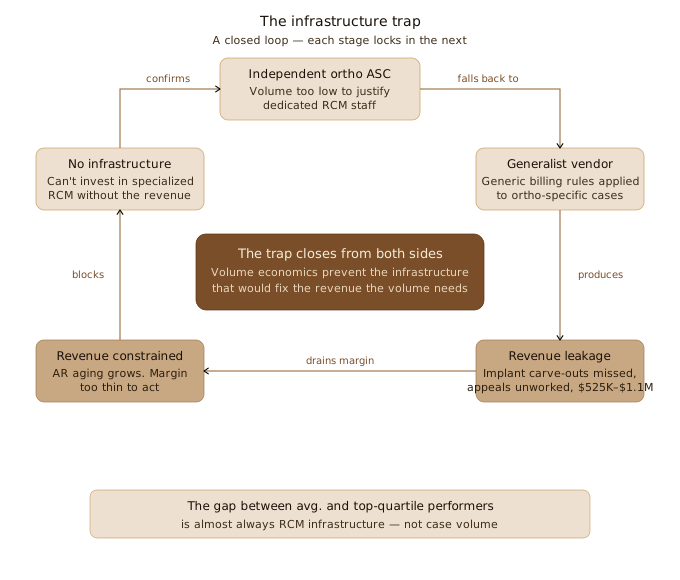
On the other hand, the default solution makes the problem worse. Mid-size ASCs that can't justify dedicated staff typically fall back on generalist billing vendors. Generic billing operations treat surgical implants as inclusive in the ASC facility fee, while specialized billing operations treat them as contractual carve-out opportunities requiring separate billing and reimbursement. The same logic applies across modifier usage, bundling rules, and payer-specific prior auth criteria. General vendors apply broad billing rules that miss the case-level complexity where orthopedic revenue is actually won or lost.
What this costs a mid-size ortho ASC annually:
| Infrastructure Gap | Estimated Annual Revenue Leakage |
|---|---|
| Implant carve-outs billed incorrectly | $200,000 – $400,000 |
| Avoidable prior auth denials | $150,000 – $300,000 |
| Unworked or lost appeals | $100,000 – $250,000 |
| Modifier errors on complex cases | $75,000 – $175,000 |
| Total estimated leakage | $525,000 – $1,125,000 |
The result is predictable. The ASC is making a reasonable resource decision. The vendor is doing what generalist vendors do. And the revenue leakage continues, claim by claim, invisibly, until it shows up in AR aging reports that nobody can fully explain.
The Institutional Knowledge Your Denial Rates Depend On
In ortho ASC billing, a significant portion of denial prevention is not processed. It is pattern recognition built over years of working the same payer panel.
Your senior biller knows that one commercial payer in your mix started quietly tightening implant invoice requirements eight months ago. They know which modifier combinations reliably clear prior auth for bilateral cases with that payer, and which ones don't. They know because they learned it the hard way, claim by claim.
That knowledge lives in one person's head. It is not in your PM system. It is not in your denial tracking spreadsheet.
When that person leaves, your denial rates do not spike immediately. They drift upward over the next 6 to 18 months as new staff rebuild context from scratch on the exact payer quirks and implant billing nuances that were previously managed invisibly.
By the time it shows up in your AR, the cause is untraceable.
What Full-Stack RCM Actually Looks Like
The denial drivers covered in this post are manageable. But managing them requires infrastructure that tracks every claim continuously, knows your specific payer mix, and doesn't lose context when staff turns over.
Most RCM vendors don't cover the full stack. Their engagements start after payer contracts clear. What happens before that, and everything that runs in parallel, goes unworked.
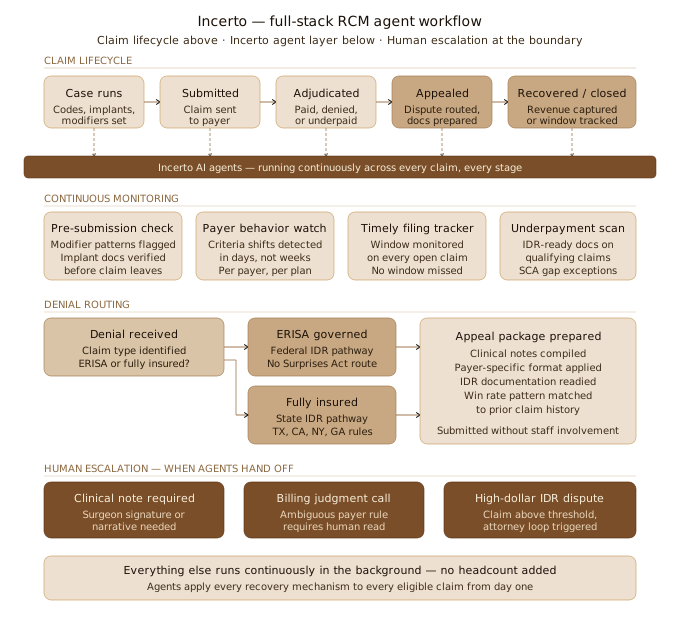
Incerto runs AI agents continuously across your revenue cycle, built around your facility's specific payer mix, case history, and claim patterns. On the denial side, the agents track modifier patterns, flag implant documentation gaps before submission, monitor payer behavior shifts in days rather than weeks, and route appeals based on whether claims are ERISA-governed or fully insured. On the recovery side, they identify SCA and gap exception opportunities before cases run, prepare IDR-ready documentation on qualifying underpayments, and monitor timely filing windows across every claim.
When a human decision is genuinely required (a clinical note, a surgeon signature, a billing judgment call), the agents escalate. Everything else runs continuously in the background.
If you made it here, Incerto would be happy to give you a free RCM audit. You can go back to the home page and book a call with us.