

The Revenue Intelligence Your Best Biller Never Wrote Down
Your senior biller puts in their two weeks. Leadership says we'll manage. A replacement is lined up, the team is experienced, and the workflows are documented. The transition feels under control.
For the first few months, it is.
Claims keep moving. Denial rates hold. Collections look normal. Nothing in the reports signals trouble.
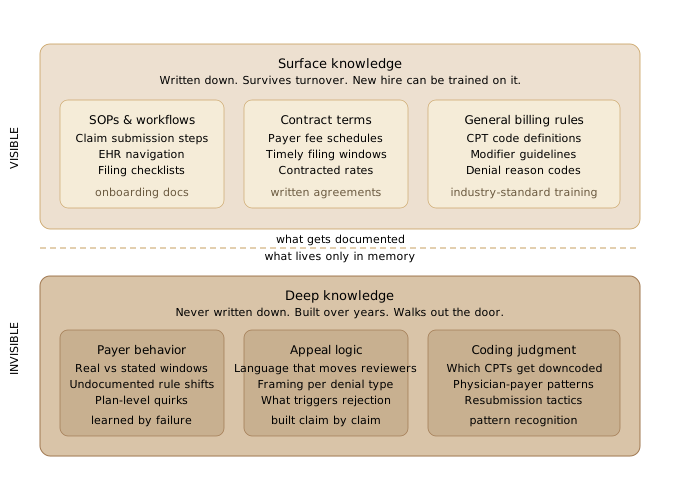
What nobody accounted for is everything that was never written down. Not the standard procedures, those exist. What is missing is the judgment layer that drove your highest-margin recoveries. Six years of knowing which Medicare Advantage plan quietly shifted its bundling rules mid-year. Which appeal language actually moves a Cigna reviewer versus which phrasing gets a form rejection every time. Which attending physicians get their high-value CPT codes downcoded at specific payers, and the exact resubmission sequence that recovers that revenue.
This is not general billing knowledge. It is your organization's revenue intelligence, built claim by claim, denial by denial, over years of pattern recognition that no onboarding checklist captures. It did not live in your system. It lived in one person's working memory. And the day they left, so did a measurable percentage of your collectible revenue.
What Institutional Knowledge Actually Means in RCM
Most people hear "institutional knowledge" and think of things like where files are saved or how to navigate the EHR. In RCM, it is the direct driver of net collections.
It is the biller who knows that a specific regional BlueCross plan has a 90-day timely filing window on paper but operationally rejects anything past 75 days, learned the hard way after a string of write-offs two years ago. The biller who knows that a particular hospitalist group's documentation style triggers medical necessity flags at UnitedHealthcare, and that one specific line in the appeal letter resolves it 80% of the time. The understanding of which contracted rates have carve-outs your own contract team has forgotten about, and how to use them on high-dollar claims.
This knowledge does not come from training. It comes from repetition, from failure, from quietly noticing what works and what does not across hundreds of claims over years.
The reason it never gets documented is not negligence. It is because the people who hold it are too busy using it. Every day. To keep your revenue cycle running.
Your most experienced billers are not just processors. They are the institutional memory your net collections rate depends on.
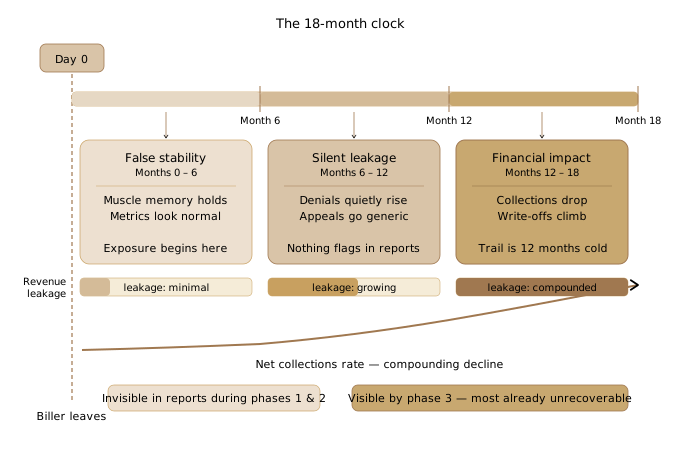
The 18-Month Timeline: Why the Revenue Damage Is Already Done by the Time You See It
The financial damage from losing a senior biller does not show up immediately. It compounds quietly, and by the time it surfaces in your reports, a significant portion of the recovery window has already closed.
| Phase | Timeframe | What's Happening |
|---|---|---|
| False Stability | 0 to 6 months | Existing habits and muscle memory carry the team. The new hire follows documented workflows. Surface metrics hold. |
| Silent Leakage | 6 to 12 months | Payer-specific denials begin climbing. Appeals are filed but recovery rates quietly drop. Under-coded claims pass through unchallenged. |
| Financial Impact | 12 to 18 months | Net collections percentage falls. Write-offs increase. Leadership starts asking questions but the trail is cold. |
0 to 6 Months: False Stability
The new hire is following your SOPs and the remaining team is covering gaps from memory. Payer-specific strategies, coding patterns, and appeal sequencing are still being executed correctly. The loss has not yet propagated into the numbers.
Leadership sees stable denial rates and normal collections. The assumption that the transition went well starts to solidify, which is exactly when the real revenue exposure begins.
6 to 12 Months: Silent Leakage
Payer-specific denial rates begin rising on claim types your previous biller handled with precision. Appeals are being filed, but the language is generic and overturn rates are quietly falling. Claims that would have been coded more aggressively are passing through at face value. The revenue difference per claim is small, but it is happening hundreds of times a month.
The remaining experienced staff are being pulled into issue resolution more frequently, becoming the next single points of failure.
12 to 18 Months: Financial Impact
Net collections percentage has measurably dropped. Denial rates on specific payers are up. Write-offs are climbing on claim categories that were previously recoverable.
Leadership is now asking what changed, but the trail is 12 months cold. Recovery at this stage means rebuilding revenue intelligence from scratch, under financial pressure, with a team that does not yet know what it is missing.
RCM staff turnover runs at 30 to 40% annually. In a team of ten billers, three to four cycle out every year. Each departure starts its own 18-month revenue erosion clock. The compounding effect is what makes this a CFO-level problem: a structural revenue leak that resets with every departure, invisible in real time and expensive to diagnose in hindsight.
What Shows Up in the Numbers
By the time the financial impact is visible, most of it is already unrecoverable.
| Metric | Healthy Benchmark | What You're Seeing by Month 18 |
|---|---|---|
| Net Collections Rate | 95 to 98% | Drops to 88 to 92% |
| Denial Rate | 5 to 8% | Climbs to 12 to 18% |
| Appeal Overturn Rate | 60 to 70% | Falls to 35 to 45% |
| Days in AR | 30 to 40 days | Stretches to 50 to 65 days |
| Write-off Rate | Under 2% | Reaches 4 to 6% |
- Net collections dropping: A 5-point drop on a $20 million revenue cycle is $1 million leaving quietly every year, with no line item to explain it.
- Denial rates climbing: Claims are hitting the same payer walls repeatedly because nobody remembers why those walls exist or how to route around them.
- Appeal overturn rates falling: The claims are being filed. The documentation exists. The contextual judgment that drove recoveries is gone.
- Write-offs increasing: The timely filing window has closed. That revenue is permanently gone.
None of these metrics point directly to knowledge loss. They look like a process problem, which is what makes them so expensive to misattribute.
Why the Standard Fixes Don't Recover the Revenue
When denial rates climb and collections drop, the instinct is to train harder, document more, and shadow longer. These are reasonable responses. They are also insufficient.
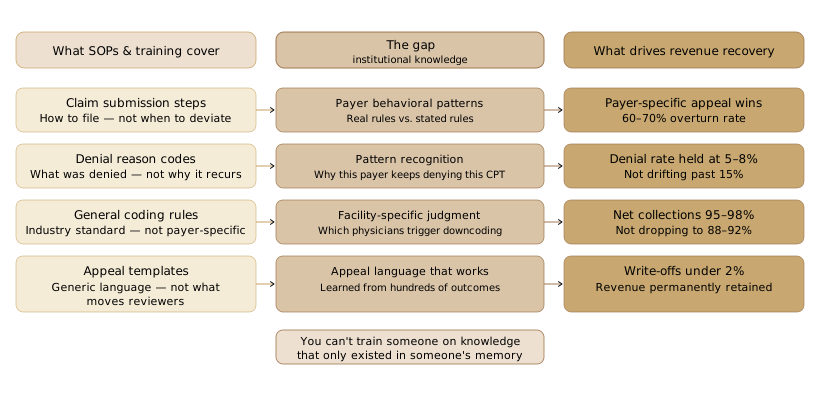
SOPs capture process. They do not capture the revenue-driving judgment on top of it. A new biller can follow every step in your onboarding checklist and still not know that a specific Humana plan in your market rejects physical therapy claims without a modifier your previous biller added instinctively on every submission.
The gap is not effort. The gap is that the decision logic behind your highest-value claims was never captured anywhere. You cannot train someone on knowledge that only ever existed in someone else's memory.
Systematizing Revenue Intelligence
The organizations that hold onto revenue through staff turnover have made one fundamental shift: they treat revenue intelligence as an organizational asset, not a personal one.
| What Most Teams Do | What High-Performing Teams Do |
|---|---|
| Document workflows and steps | Document workflows plus the reasoning behind exceptions |
| Train on general billing rules | Train on facility-specific payer behavior and historical outcomes |
| Review denials for correction | Review denials for pattern capture and playbook updates |
| Rely on senior staff for edge cases | Build edge case resolution into structured reference systems |
| Lose revenue intelligence when staff leave | Retain it in systems that outlast individuals |
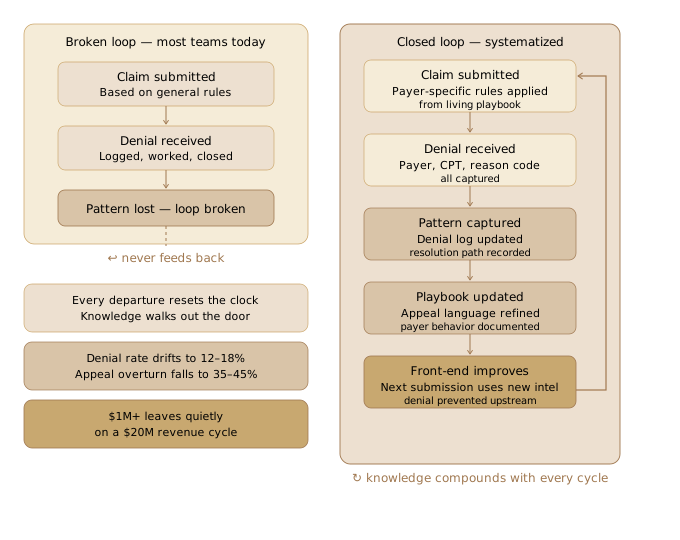
What this looks like operationally:
- Payer-specific playbooks that capture behavioral patterns: what triggers denials, what language resolves them, what documentation each payer's reviewers actually respond to.
- Denial pattern logs maintained as living documents, updated every time a new resolution path or successful appeal strategy is discovered.
- Coded claim rationale tracking so that coding decisions on complex or high-value claims are documented with reasoning, not just recorded as outputs.
- Feedback loops from appeals back to front-end teams so that denial intelligence reaches the people submitting claims before the denial happens.
The team that does this consistently builds a compounding advantage. Every departure becomes less damaging because the knowledge stays in the system.
The Competitive Reality
The organizations that consistently outperform in RCM are not necessarily the ones with the best billers. They are the ones where the best revenue thinking never leaves.
With 30 to 40% annual turnover, a 10-person billing team is effectively a different team every 2 to 3 years. What is solvable is whether the revenue intelligence those people built walks out with them or stays embedded in your operations.
The facilities that close this gap compound their advantage. The difference shows up directly: 3 to 6 points higher net collections, denial rates held at 5 to 8% instead of drifting past 15%, and appeal overturn rates that do not collapse every time a senior biller exits.
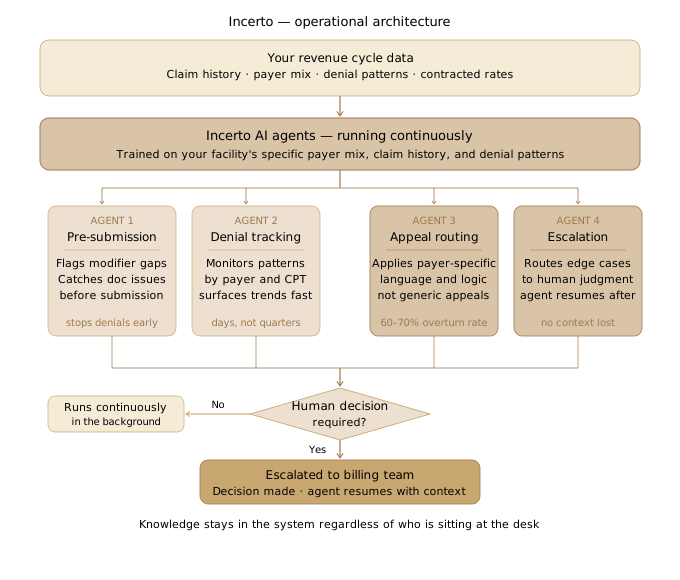
This is exactly the problem Incerto is built around. Incerto runs AI agents continuously across your revenue cycle, trained on your facility's specific payer mix, claim history, and denial patterns. The agents track modifier patterns, flag documentation gaps before submission, monitor payer behavior shifts, and route appeals based on what has historically driven recovery in your market. When a judgment call genuinely requires a human, it escalates. Everything else runs continuously in the background.
The real risk was never someone leaving. It was every dollar of collectible revenue that left with them. The organizations that solve this do not just recover better. They pull ahead in ways that are very hard to close.
If you made it here, Incerto would be happy to give you a free RCM audit. You can travel back to the home page and book a call with us.