

The Pattern No Single ASC Can See
A mid-sized orthopedic ASC starts seeing more denials on CPT 29881. The billing team digs in, files appeals, adjusts documentation. Three months later, they will figure it out: UnitedHealthcare quietly tightened medical necessity criteria. Revenue lost in the process: real, measurable, unrecoverable.
Forty miles away, a different center is about to spend the next three months figuring out the same thing. And the center after that. And the one after that.
Payers don't run experiments on one ASC. They run policy across all of them. The damage shows up one center at a time.
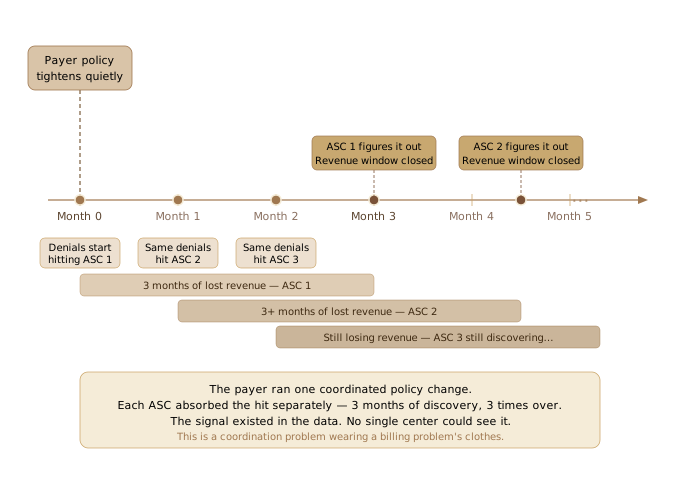
This is what makes denials a different kind of problem. It is not an operational failure. It is an information problem. The signal exists in the data, across centers, across quarters. But no single ASC has enough claims volume to see it early enough to act on it.
So everyone absorbs the hit separately, quietly and in isolation.
Why Denials Are Where Isolation Is Most Expensive
Payers are not making ad hoc decisions. They have actuaries, policy teams, and claims data across thousands of facilities. When they tighten criteria on a procedure, they do it as a coordinated policy shift across every ASC in their network. Simultaneously, with no warning.
What happens on the ASC side is the opposite of coordinated.
A payer sees the pattern across 10,000 claims. Your billing team sees it across 200. That is not a fair fight.
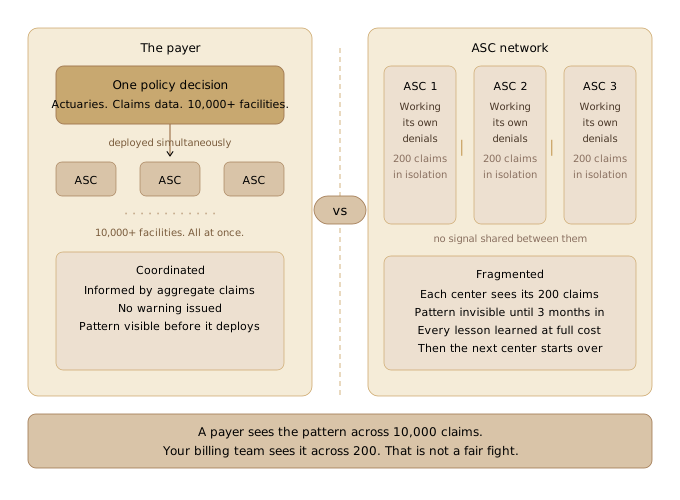
Each center works its own denials in isolation. The appeal that failed at your center last quarter failed at three others too. The modifier that stopped working, the authorization requirement that quietly changed, the op note language that used to hold and now does not. Every one of these is a lesson that gets learned independently, at full revenue cost, by every center in sequence.
By the time your team figures out what changed, the window to recover the earliest denials has often closed. The revenue is gone. And the center down the road is just starting their own three month discovery process on the exact same issue.
This is not a billing problem. It is a coordination problem wearing a billing problem's clothes.
The signal is there. It just does not exist inside any one center's data alone.
What Solving Together Actually Looks Like
Every billing team has that one person. The one who just knows that Aetna tightened criteria for knee replacements last quarter. Who catches the UnitedHealthcare modifier issue before it becomes a denial pattern. That knowledge did not come from a manual. It came from enough volume and enough time to see the pattern.
Now imagine that person had not seen your center's 200 claims. They had seen 20,000, across 30 centers, across every payer, across every quarter.
What your best billing person knows is limited by what your center alone has seen. What if they can see the bigger picture?
This is the gap Incerto is built to close. Not a shared dashboard. Not a quarterly benchmarking report. A system that runs continuously across every center it touches, learning from every appeal outcome, and applying that learning before the next center sees the same denial.
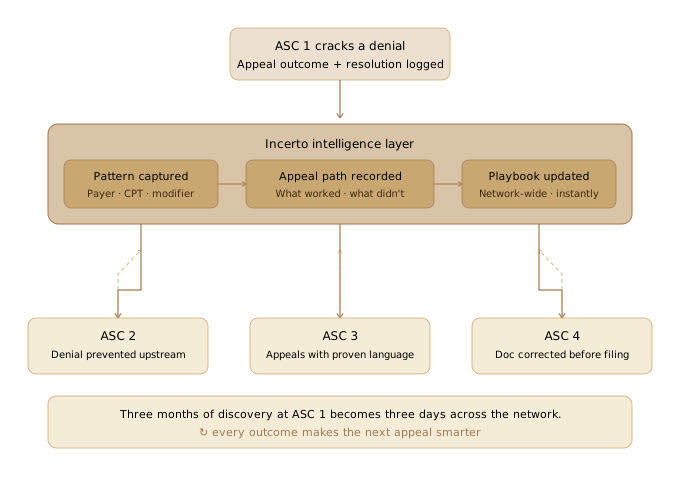
Incerto is the cross-center intelligence layer for orthopedic ASCs.
When one ASC on the Incerto network figures out that a specific payer is rejecting a modifier combination unless documentation meets a new threshold, every other ASC knows it immediately. The appeal quality compounds. The pattern recognition gets faster. What took one center three months to figure out takes three days across the network.
If This Resonates, Let's Talk
Denials are not going to get easier. Payers are getting more sophisticated, authorization requirements are tightening, and the window to appeal keeps shrinking. The centers that recover the most revenue over the next three years will not be the ones that work harder on denials, but the ones that see the patterns first.
That is what we are building at Incerto. Cross-center denial intelligence for orthopedic ASCs.
If you are sitting on a denial backlog and suspect the problem is bigger than your center alone, I would like to show you what this looks like in practice.